

Tiefanue
The nation of Tiefanue is a large nation settled along the southwestern edge of Maud’madir, and is known for being the first Human kingdom founded upon the continent. Born from the ashes of the Human race’s rebellion against the Grey Elves, these early Humans cast aside their would-be patron’s distrust of the divine and instead embraced the Gods of Light, dedicating their very nation to their cause. For centuries they endured every test that Arthos would throw at them, secure in the knowledge that so long as they held true to the Light, their nation would not fall.
However, recent events have left much of their nation in ruins after corruption took hold within the Church of Light, with more than half their population slain during the Hell King’s invasion. It has fallen to those that remain to pick up the pieces, negotiate a new relationship with their Gods, and rebuild their once great and powerful nation.
Demographics: 65% Humans, 5% Mountain Dwarves, 10% Hobling, 10% Savar’Aving, 10% Other
Major Exports: Agricultural/forestry products, fish, and blacksmithing products
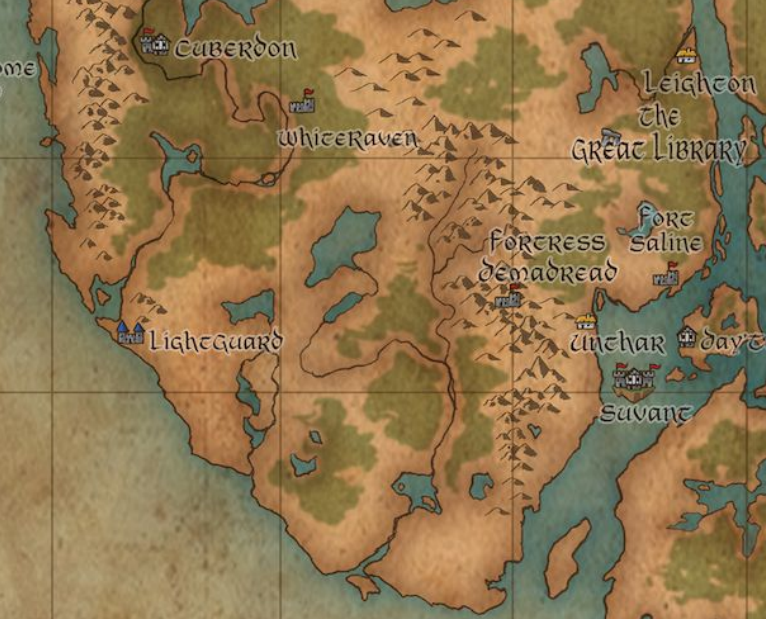
Contents
History
Origins
In the earliest years of Arthos there were only the Grey Elves, for the other peoples of the world had not yet come into being. These strange and powerful elves were perpetually shrouded in mystery, and even today little is known regarding their origin. Back then, as today, the Grey Elves saw themselves as the paternal race, the protector, scholar and judge of all the lesser races that would come after. It is unknown from where they came, but the second race to appear upon the surface of Arthos were the dwarves. They met with the ambassadors sent by the Grey Elves, but ultimately refused their offer of sanctuary and tutorage and they retreated into solitude beneath the mountains to the East. They were more successful with the next races to make their appearance, the Avians, the Savar and the Hoblings. All made their home within the protective arms of the Grey Elves before venturing out onto their own and forming their own domains with the blueprints given to them by their former mentors. Many races refused and even rebelled against the molding hands of the True Thalan, including the Orcs, Goblins and other ‘greenskin’ peoples. The last race to make their appearance upon Arthos was humanity. They initially accepted the Grey Elven offer of temporary sanctuary, but quickly began to resist the “brainwashing” and learned instead to resent their captivity, growing ever more resentful against their would-be masters. “We shall be no one’s pet” became the infamous rallying cry, which for the first time stunned the Grey Elves into a near fatal mistake; they simply refused the Humans their freedom. From the ivory heart of the Grey Elven capital, a violent and merciless rebellion erupted. The Grey Elves were completely unprepared for such a brutal uprising, as the Humans drove into the very chambers of the High Council itself, murdering each member where they sat. In shock the remaining parliament fled to the deep woods instead of defending their city.
These first Humans had won their freedom thanks largely in part due to the blessings of the Gods of Light. For without their aid, it is doubtful that they would have been able to counter the vast powers of the Grey Elves. On the eve of their victory, it is said that the God Roland himself descended from the heavens, and bestowed upon the Human leader the literal divine right to rule, placing the crown of Tiefanue upon his brow. These Humans founded what would one day become Castle Lightguard upon that very spot, and as the centuries rolled on their expansion was gradual and measured, ever in accordance with the principles valued by the Light. For most of its existence Tiefanue eyed its newer Berphauntian neighbors warily, but rarely engaged in conflict with them, and indeed even offered them the aid of their royal navy during the Eastern War. However, Tiefanue seemed content to simply exist as it had for hundreds of years, for they were the ancient bastion of Human civilization, and they lived only to give glory to the Light.
The Rise of the Black Wyrm
The Firstborn known as Styphon has been one of the greatest threats to Tiefanue’s existence, for his philosophical outlook is inimical to the philosophies presented by the Gods of Light, and the presence of these accursed astral leeches upon his land inflames his prodigious anger. He began by denying the Gods the chance to make all their Human servants immortal, and has continued to visit death upon the Human race ever since. Were it not for the direct support of the Gods of Light and their servants, it is an undeniable fact that Tiefanue would have fallen long ago. Indeed, it might still have fallen were it not for Styphon’s need to slumber every few centuries.
The last war with Styphon began in the year 2242 when he awoke from slumber and formally declared war on Tiefanue and the Church of Light. The Vulcan Dwarf city of Skalden within Mount Dracos was conquered early in the war and its population enslaved, with Dragon Knight Vlermis the Indomitable installed as overseer. Multiple Tiefanese towns fell to the Army of the Black Wyrm including Leighton, Atlitaia, Bolosur, Catherana, Estatrene, and Sumantis. A large section of formerly Tiefanese territory was conquered and became known as the Black Crescent, ruled by Styphonite Commander Xavier Leiche, with no remaining military resistance from Tiefanue within its borders. The Order of the Gilded Shield, a sect of Roland knights, was established in a monastery northeast of Tiefanue specifically to aid in its defense. The town of Ravin successfully defended itself against the Army of the Black Wyrm with angelic assistance, but was surrounded and cut off from supply routes. Through the direct intervention of the Gods of Light, the war ended in the year 2256, as the angelic reinforcements ground down the waves of Undead alongside the armies of the faithful. However, the effects of the war were still felt years later, such was the damage. The town of Whiteraven was populated by Tiefanese refugees still fleeing the war as late as 2258. At the Whiteraven Accord that year, King Roland the First stated Tiefanue had lost “people, land, and reputation” to Styphon’s forces. Tiefanue’s land and naval forces were described by a Wolven delegate at the Accord as having been “destroyed from within and without, by Styphon and Berphaunt.”
The Brood War
Tiefanue was never directly affected by the armies of the Brood, but King Roland was far from blind to the dangers they represented. Thus, when Berphaunt called the other nations of Arthos to council, claiming to have further knowledge of this insect menace and a plan for dealing with them, he sent his son and heir to treat with King Louis in his stead. The prince could not have been more shocked, when over the corpse of the last son of Clan Sprawn, King Louis Berphaunt explained his plan. All would submit to his rule, and thus united his new empire would crush the incoming Brood menace utterly. Unsurprisingly, Prince Leopold was not alone when he rejected such terms. Not only was the thought of surrendering their respective nation’s sovereignty inconceivable, but none amongst their ranks trusted a rival nation so thoroughly plagued by the interference of the Firstborn known as Shiloth. Thus, those who refused to submit to Berphauntian tyranny gathered at the village of Whiteraven not long after, and it was there that they signed the original Whiteraven Accord. An alliance of mutual aid and defense, signed and sealed under the watchful eye of the Church of Light.
Subsequent years would see the new alliance tested as they matched their might against the Brood, but death at the chittering hordes was not the only ordeal the young prince would face. In secret he had met Princess Louisa, daughter of the newly crowned Emperor of Berphaunt, who had begun to fear for her life. Strange accidents had begun to befall the Emperor’s children, save for the son given to him by the new Empress Annadonna Cordelle. Leopold, being the honorable and just man that he was, gave aid and succor to the young princess. Over time that relationship blossomed into love, and it was not long before Louisa was with child. Sadly, it seems that no matter how far she fled, nothing was truly out of Shiloth’s reach. Her young child was slain by agents of the Shadow Dragon while it was still within her womb, and torn by grief she swore herself to Raze, the Goddess of Vengeance. This forever drove the two young lovers apart, but for his part Prince Leopold still did not stop loving the woman he had felt would be his future queen.
Louisa was slain less than a year later by Shiloth herself, in a move so petty it can only be described as a fit of pique. Still, the sense of loss shared by both her former lover and her father bound the two men together, and for the first time in several years the animosity between their two realms was gone. In honour of his daughter’s memory, Emperor Louis promised to restore Prince Leopold to his throne. Tragically, he would never get that chance.
The Hell King
The year 2265 was especially grim for the Tiefanese people. The venerable King Roland Tiefanue was assassinated, slain as he sat upon the throne from which he had ruled from with honour and wisdom for decades. At the time Roderick Hale had proclaimed that his men had caught, tried and executed King Roland’s killer, but the speed at which the Archbishop expanded his total control over all of Tiefanue did not go unnoticed. Even those simple folk who were utterly faithful to the Gods and their mortal representatives began to whisper, but at the time there was not much to be done. The last great hope for the bloodline, Prince Leopold, was in hiding and had made his distrust of the Archbishop all too clear.
The rest of Maud’madir seemed to agree, as many had not forgotten the Archbishop’s betrayal of the allied forces that slew the ruinous Firstborn Ta-Ba-Ret and her god-puppet Ga’more. Thus, once again did the heroes of Arthos come together once again, this time to stop Roderick Hale, or whatever he had become. His former Paladin, a Wood Fae by the name of Asher of the Dawn, seemingly broke off from Hale’s control and convinced the forces present that the Archbishop was himself either a powerful Demon, or entangled with one. Given his tyrannical actions as of late, this was not a hard thing to believe, and the lie would only be discovered once it was too late. Hale had brought with him to the battlefield a most ancient, vile, and powerful Wytch; the very first of their kind. Known to most as the Black Wytch, Asher had convinced the heroes present that she would have to be slain first if they were to have any chance at laying the Archbishop low. And due to choices made earlier that day, there was but one method by which she could be slain.
The crown of King Roland Tiefanue had been recovered by the Savar’Aving, and with it Prince Leopold could call down the righteous fury of all of the Gods of his people. Such raw power would come with a cost however, as it was not so easily controlled by mortals. Nevertheless, the Prince was a noble soul, and was willing to pay whatever price was needed to deliver his people from darkness. After a great and terrible battle against the Black Wytch and her servants, he bid the heroes of Arthos one final goodbye and placed the crown upon her head. The resulting explosion of pure, divine light utterly consumed them both, killing the Black Wytch, but also completely annihilating the holy bloodline that had ruled Tiefanue for time immemorial.
The victory over Hale was a hollow one, as their supposed victory revealed only that the Prince’s sacrifice was an engineered gambit by the Hell King himself! Hidden with the body of Asher, he had manipulated those present upon the warfront into destroying both one of the few relics capable of harming him, and one of Arthos’ greatest heroes.
That would not be the end of the Hell King’s strikes against Tiefanue however, for even bereft of their most powerful treasure and their rightful sovereign, they were still a threat to his plans. Unbeknownst to most citizens of Arthos, many of those divinely Favoured who were slain by the divine severance wrought by the King of Demons did not meet their final death. Instead, their tormented spirits were dragged before the Hell King seated upon his black throne, and offered a choice: Serve, or be unmade. The former priests and warriors of the Light each had their own reasons for embracing the King of the Hellstack Plane, but such distinctions hardly mattered to their future victims. For nearly two years these traitors and their demonic allies ravaged Tiefanue. Her citizens were slaughtered, her holy places defiled, and her treasures looted and put to vile purpose. Were it not for heroes like Avandra Ironarm, the whole of Tiefanue might have been snuffed out before the forces of Arthos managed to slay the Hell King in the year 2267.
The Tiefanue that the survivors have inherited is a pale shadow of the great and mighty kingdom it once was, but its devout and steadfast citizenry is committed to restoring it to its rightful place amongst the nations of Arthos.
Geography
For much of its history, Tiefanue was known to all as the land of milk and honey. Blessed by the Gods of Light themselves, its gentle rolling hills and thick verdant forests provided for all. It is said without jest by many that the plains of Cassandra’s Celestial Realm are merely just the improved version of Tiefanue’s pleasant landscapes, and that there is no better place to live and raise a family on all of Arthos. Fresh, clean water is abundant from its many lakes and rivers, and those very same aquatic pathways facilitate the rapid movement of both people and cargo across the country. Save for perhaps the eastern mountain ranges, no expanse within Tiefanue’s borders could be considered inhospitable or inimical to mortal settlement.
In the present day, much of that is still true. The survivors of the Hell King’s invasion still farm some of the best soil on Arthos, and their foresters harvest the best lumber in the west. However, much like the people of Tiefanue, the land itself is not without its scars. In some cases, these scars are merely the ordinary result of conflict. Homes destroyed, storehouses looted, forests burnt, and so on. However, in other cases the damage inflicted upon the land goes beyond the simple ravages of war. These areas have been deemed Curselands by the Church of Light, and are blighted by all manner of hell-tainted magics. Many of these were places formerly sacred to the Light, and their subsequent desecrations were a deliberate act to weaken those still faithful to the Gods. The exact nature of this corruption varies from place to place, but all are inimical to mortal life. These include a blighted section of the northern forests where all the plant life is twisted and foul, and possessed by a murderous hunger for living flesh, or a grey ashen waste where one’s life force is drained from them in seconds. Such is the danger of these places that the Church of Light has asked that no citizen attempt to breach their borders, no matter what manner of treasure or knowledge that may lie within. Only once the Church has had the chance to burn away the demonic corruption that grips these lands, may the people of Tiefanue begin to resettle these areas.
Settlements
Castle Pembroke
Long abandoned, this once mighty fortress once stood as a decaying symbol of Tiefanue’s diminishing power and internal corruption. Built when the power of the royal bloodline was at its zenith, its subsequent descent into ruin almost seemed to reflect Tiefanue’s descent.
However, for reasons known only to her, Avandra Ironarm chose these seemingly cursed grounds to be the place upon which she would begin to rebuild Tiefanue. Now, the reports coming out of Castle Pembroke are joyous ones. Crops are being grown, houses built, and its fortifications repaired by the hands of skilled craftsfolk. The massive public square is particularly inspiring, with the statues of the former King Roland and his sons flanking the newly restored community fountain. The once-accursed castle now stands as Tiefanue’s capital, with both the Hammered Host and the Order of the Blood Red Rose encamped behind its newly constructed walls, ready to serve Tiefanue as protectors should the need arise.
Lightguard
Originally known as Tiefheim, Lightguard once stood as the capital of Tiefanue, serving as both the seat of the royal family, and the headquarters of the Church of Light. The entire city was a work of art, crafted by the most skilled artisans on Arthos and further beautified by artists beyond compare, it was an attempt by the Tiefanese to accurately reflect the glory and beauty of their gods. Not even the richest Berphauntian noble could have dreamt of living in a manor so magnificent as one of their storehouses! But alas, all of this gleaming marble and burnished gold was but a mask for the insidious rot that wormed its way into the heart of the Church of Light. When the veil was finally torn from the eyes of mortals and the Hell King made himself known to all, his armies violated the once holy grounds of Lightguard. Symbols of the Light were profaned, its towers cast down, and its once pure fountains transfigured into fonts of rotten blood. It was thought by many that such was its corruption, that Lightguard would forever remain a blighted hellscape.
The Trinador however, had other ideas. They would not let such corruption be, and requested that the land be turned over to their control. Avandra agreed, and the Trinador moved the floating Final Bastion over the site shortly thereafter. They have since spent an innumerous amount of time cleansing the land with their holy magics, driving away the hell-taint with the sort of might only former angels such as they possess. While the work is not yet done, Lightguard is beginning to resemble the place of light and beauty it once was.
Whiteraven
Once a small village of no more than fifty people, the stewardship of Mayor Yolanda Smythe and its selection to be the site of the original Whiteraven Accord talks saw this town’s size increase tenfold rather quickly. The subsequent security concerns saw the Tiefanese military establish a significant presence within Whiteraven, and they remained even after the talks had concluded. For one reason or another, Whiteraven was one of the few towns not sacked by the armies of the Black Eclipse, and as such remains one of the few still intact military bases in Tiefanue. The remnants of those Tiefanese soldiers who survived the war still garrison it to this day, as Whiteraven contains a rare, functional Skein Gate and is the entry point for many foreigners making their way into Tiefanue.
Leighton
Leighton was a sparsely populated outpost town on the northeast tip of Tiefanue, historically the gathering point for the push into the Grey Elven forests to the east, and the source of the seed population of Jericho. On November 10, 2242 it was assaulted and sacked by forces under the Tiefanese Baron Edward Von Teetterson, flying the colours of Styphon. Tiefanue stripped Von Teetterson of his title and placed a 1,000 gold bounty on him for treason. In spring 2251, reports emerged that Leighton’s citizens had been rounded up, flayed alive, slain, and raised as Undead. Von Teetterson subsequently lost control of the town to his son and was placed under a form of house arrest. By that point the town was 95% Undead, with even Army of the Black Wyrm soldiers treating it as a place to avoid. In 2254 it was razed by angelic forces searching for an individual named Riktor, without success.
In the present day it remains an accursed, ashen ruin. Even those who do not possess the second sight can feel the waves of suffering and darkness that have since forever emanated from that dark place. It has remained abandoned ever since, and will likely remain so for the foreseeable future.
Coppergate
This bustling mining town was both the birthplace of Avandra Ironarm, and the beginning of the real Tiefanese resistance against the Hell King. Several years ago a brutal, savage battle was fought before the town’s enchanted copper gate, one that would have likely seen the town slaughtered to a man were it not for Avandra’s heroism that day. Since then, it has continued much as it had before. Much of Tiefanue’s mineral wealth is pulled from a selection of mines not far outside its stone walls, and every bit of ore is then channeled into Tiefanue’s reconstruction efforts.
Culture
Tiefanue considers itself a morally superior nation, or at least it did for much of its history. The worship of the Gods of Light is a fundamental part of their culture, and despite the recent rash of demonic corruption that infested the church, those foundational principles still remain. The Tiefanese people pride themselves on being honourable, law-abiding, selfless, and kind. Anyone who needs help can count on their neighbors to provide it, and even in these current times of scarcity it is rare for a person to stave, or lack for a roof over their head.Theirs is an egalitarian society, one where men and women hold equal rights, and marriage is a mutual decision. Bondage of any kind is seen as an affront to the gods themselves, and they look dimly upon any person and that would enslave another.
By the standards of more urbane peoples, the Tiefanese are perhaps a bit more simple or earthy. They favour simple direct talk, plain food, and mild drink. What elements of high culture they do possess are often targeted towards the church, with most of their artwork and grand architecture focused on elevating and giving glory to the Gods. Anything else is seen as profane, and those few nobles that gussy up their own estates in such a manner are often looked upon as blasphemers at worst, or gaudy show-offs at best.
The Tiefanese place great value on helping those in need, regardless of the severity of their own situation or ability to help. In the year 2268, a group of enterprising philanthropists founded a string of charities all across Tiefanue. Simply known as the Society of Leopold, these charities aim to uplift those who would otherwise fall between the cracks of Tiefanese society, and to ensure that no citizen lacks for food or a roof over their heads.
Government and Politics
For centuries Tiefanue was ruled by the blessed King Roland the First. His bloodline alone had received the gift of immortality from the Gods of Light, and fortunately for the people of Tiefanue the Gods had chosen well. King Roland ruled his people with wisdom, honour, and skill for centuries. He never married or passed down the throne to any of his descendants, but he did father two children by an unknown mother; Roland the Second and Leopold. It was said that it was Leopold who held the full measure of his father’s favour, and was being groomed for the throne in a slow and careful manner, before the current turmoil of the past decade forced Leopold into another role. It is then perhaps no surprise that much of Tiefanue’s current woes began with the assassination of King Roland, and the subsequent self-sacrifice of his last son and heir, Prince Leopold. The magic the former prince employed burnt his bloodline from the face of Arthos, thus ensuring that whatever came next would by necessity be something entirely new to the Tiefanese people.
The system that rose from the ashes of war-torn Tiefanue is a more fair and democratic one, one born of mistrust of the selfish nobility and corrupted priests that plunged the common people into hell. While some small portion of the former Tiefanese nobility does yet remain with their titles and lands, these folk have quickly discovered that their birthrights no longer grant them the sort of political power and influence they once had. The Hellstack’s invasion had a multitude of effects upon the social hierarchy of Tiefanue, but perhaps one of the largest ones was putting truth to the lie that noble blood granted one supremacy over another.
Each settlement elects their own representative in the manner of their choosing. Many are mayors or chieftains elected by a simple popular vote, while others may be important political or economical figures such as Coppergate’s head foreman of the miner’s guild. The Church of Light also participates, sending one bishop for each God under their purview. These representatives meet annually at Castle Pembroke for the Grand Council, for it is there that these representatives introduce new legislation, vote on the laws of the land, and so on. The system itself is still quite new, and as such is often chaotic and prone to breakdowns in decorum. Physical fights have even been known to happen from time to time, with those responsible quickly finding that Avandra has no patience for such poor behaviour.
The Steward
In times of duress when quick decisions are needed, a slow moving council of folk with a diverse array of opinions and desires cannot rise to the occasion. When the war against the Hell King was won, Tiefanue’s numerous problems were plain to all, as was the necessity of a strong leader to put things to right in a quick and efficient manner. Avandra was called upon to ascend the throne left vacant by the previous royal line to be that leader, but she outright refused to be just another queen. Her exact reasons for doing so are unknown, but those who served beside her in the war were unsurprised by the decision. Nevertheless, Tiefanue still needed a leader, and after a significant amount of pleading, Avandra agreed to serve her home as its Steward. The position carries with it no other titles or lands, nor does it elevate the holder above the common masses by right or privilege. It is by design, a role that marks one as a servant of the people, and not the other way around. The powers it does grant are simple. When the Grand Council meets, the Steward has a vote like any other councilor, save that their vote counts as an extra vote in the case of a tie. The Steward is also responsible for setting the agenda, appointing candidates to ministerial positions, and so on. In times of emergency when the council cannot meet, the Steward acts with their authority, and may direct the various apparatus of the Tiefanese state as they see fit. However, doing so carries with it a certain kind of political risk, as the Steward may be removed from their position by a supermajority vote of sixty-five percent or higher, should the Steward be considered to be abusing their authority by the council.
High Laws
- None will suffer the use, distribution, and/or creation of any or all Wytchcraft magic and/or items, or any other contractual dealings with demonic forces.
- None will suffer the use, distribution, and/or creation of any or all Necromancy magic and/or items, nor are any dealings with denizens of the Death Plane to be permitted.
- Slavery is illegal within Tiefanue. Any slave that manages to cross into Tiefanue’s borders is considered to be a free person, with all the rights and privileges accorded to a citizen of Tiefanue.
- Worship of any of the Dark Pantheon is not permitted within Tiefanue, nor is the reverence of the following Firstborn: Ixiad, Styphon, and Ilyxtriak.
- Those born on Tiefanese soil are Tiefanese citizens, additionally the Steward or another council representative may grant a foreigner citizenship by a simple decree.
- The tools of the assassin not including but not limited to garrotes, stilettos, Forget alchemy, Death and Slow Death alchemy, Feeblemind alchemy, and any form of Ambrosia are forbidden to possess. Only those with a writ of possession signed by an official council representative may hold these tools, and only for the purpose stated upon the writ.
- The desecration of holy ground, sacred relics, or sites consecrated to the Gods of Light is forbidden within Tiefanue’s borders.
- No citizen of Tiefanue may take up arms in service of a foreign power against Tiefanue or her allies without being considered a traitor to the homeland.
Military
Organization and Forces
The vast majority of Tiefanue’s armed forces were shattered in the last war against Hell, and its remnants were long ago absorbed into the Hammered Host. Nothing presently remains of their previous command structure or support systems, and few of the old fortresses and castles are anything but worthless rubble. Tiefanue was one of the first targets when the Hell King’s invasion began in full swing, and it suffered greatly as a result. Even its navy did not escape hell’s wrath, and most of their ships were razed by hellfire, and a seaworthy vessel is not something so easily replaced. However, despite the decimation of their forces at demonic hands, Tiefanue is far from defenseless. Until such time as Tiefanue can properly rebuild its military, the veterans of the Hammered Host handle all martial matters, both domestic and foreign.
The Hammered Host
More a collection of those who refused to die than a true army, the Hammered Host is what the folk of Maud’Madir began to call those who followed Avandra Ironarm into battle. Each member of the Hammered Host is a battle-tested and bloodied veteran of several pitched battles, and each has raised a blade against the most vile and destructive demons to have ever walked the surface of Arthos. Like Avandra, their will is iron and their morale unshakeable. Most militaries have but a few veterans of like quality, but in the Hammered Host each and every single last warrior is the equal of any knight or champion. They are, of course, few in number, but well worth their weight in gold.
Their equipment is a mishmash of whatever could be salvaged from the armouries before they were looted, and whatever could be taken from their fallen foes or crafted along the way. They wear no uniforms, wave no banners, and offer no salutes. These are hard men and women, killers all, and they have no time for any foppish pageantry that occupies the time of worthless noble officers.
Speaking of officers, the Hammered Host has none. Avandra is recognized as the leader of course, and all would follow whatever she commanded. The Dragon Knight Oskeladd was known to command some of her influence as well, but never dared to contradict or gainsay her commands. Typically, when the Hammered Host departs on a particular assignment, a leader is informally chosen from amongst their number. In many cases this is a person known to be someone of significant ability or stature, and often falls upon the Paladins and Lightweavers should they be present. However, this is far from a universal rule, and oftentimes the warleader is just simply someone that knows the terrain or its people better than the rest.
Economy
Trade and Industry
As much of Tiefanue still lies in ruins and so much of its populace was slain, its economic output is quite low, especially when compared to some of its neighbors. Much of the surviving populace is engaged with subsistence agriculture, and what little spare time that affords them is generally spent on the physical restoration of their lands. What few exports it still manages to produce for sale are inevitably used to purchase the supplies needed for the reconstruction efforts, or to purchase food to make up for any harvesting shortfalls.
Agriculture/Forestry
Tiefanue was once renowned for its fine horses. The Lex is a breed of horse developed southeast of the capital city, known for its fiery spirit and smooth gait. Prized as light war horses, they also serve as riding horses to the wealthy. While most of the pastures that once raised these fine beasts were razed, the lands of House Waidwell escaped this grim fate. Currently the young scion of this house is attempting to resurrect the breeding programs that once furnished these fine beasts to any who could afford their extreme cost.
The chief natural export of Tiefanue though, has always been its timber. Thanks to ancient alliances with the Grey Elves, the verdant forests of Tiefanue have always provided more sturdy timber than their lumberjacks could ever cut down in a season. These freshly cut trees are floated down Tiefanue’s many rivers to one of their giant sawmills, where they are processed and turned into a wide variety of products in demand all across Arthos. However, unlike the more rapacious nations of Maud’madir, Tiefanue does not simply take all that it can from the natural world, and damn the consequences. Druids and the priesthoods of Dunarthos and Sybil are often consulted before any major harvesting effort, with great care taken by the Tiefanese people to do no more harm than is strictly necessary, and to replace what was taken if possible. Most villages and towns will have laws to this effect, one example being that for every tree harvested, three more must be planted.
Tiefanue was also once known for its high quality mutton and wool, and for its apple and pear orchards. Today most of these products are instead consumed internally, but perhaps one day they will be found in foreign markets once again.
Fishing
While Tiefanue’s navy did not survive the Hell King’s invasion, much of the former kingdom’s fishing fleet was away when those howling demonic savages struck. Avandra could hardly believe her luck when her advisors told her that much of the fleet was still seaworthy, and were it not for their efforts the citizens of Tiefanue might have staved long before they could rebuild their country. Fishing fleets harvest tuna from the open sea southwest of Tiefanue, and red-fleshed salmon from the rivers. The salmon itself is said to be a fine delicacy, with the hoblings of Teris devouring it by the crateload. Although the southern strait is fished, fishermen never venture further east than Day’ten. It is said that fish from east of Day’ten are foul-tasting and deformed.
Smithing
Some of the highest-skilled carriage makers in Maud’madir come from Tiefanue. Tiefanese carriages are known for their excellent suspension systems, which have yet to be replicated by craftsmen in any other nation.
Tiefanue is also known for its high-quality crossbows and ballistas, and these weapons are highly sought after by mercenaries from all over the continent. Many foreign agents have come to Coppergate seeking to learn their ways, but the smiths there guard their secrets well.
Religion
The worship of the Gods of Light is ingrained within the very bones of Tiefanue. Starting with the blessing of the royal bloodline by the gods themselves, the land of Tiefanue exists as a homeland for all those who hold mercy, honour, and justice within their hearts. Even today, most citizens attend the closest weekly mass if they can. Thus it has been so for centuries, and until the invasion of the Hellstack it has ensured that all its godly citizens have survived and thrived. As such, it should be no surprise that Tiefanue has been the established home of the Church of Light. Although the betrayal of many former priests and lay folk to the Hell King has blemished its otherwise sterling reputation, it has purged these faithless sinners from their ranks, and still it remains as the most prominent moral authority upon Arthos. It does not wield the political power it once held, but it is still responsible for all matters theological, and its priests work tirelessly to cleanse the dark stains that still linger upon Tiefanue.
Dark worship is not permitted within the borders of Tiefanue, and no exception is made for any god. Any travelling cleric of a Dark god had best have legitimate business within Tiefanue and accompanied by the correct documents, lest they risk the Church’s wrath. The citizens of Tiefanue pride themselves in being good, honest folk, and have little tolerance for those who would bow before any god not of the Light.
The reverence of the Firstborn is quite uncommon in Tiefanue. The Church of Light tends to take a less extreme and more tolerant view of it than they do of Dark worship. While they make look the other way with some of the gentler Firstborn, some Firstborn are simply not permitted to be followed at all. This is likely due to their inimical creeds, one prime example being the dragon Styphon. He and his Undead armies have been a powerful thorn in the side of Tiefanue’s light-fearing folk for centuries, and evidence of his worship is something still capable of arousing the more violent and headstrong aspects of the Church of Light. However, uncommon does not mean non-existent. The service of Oskeladd, Dragon Knight of Kaltraxis, in the Hammered Host has won him and his Firstborn a small bit of favour. While it is still rare, some citizens that have been unable to forgive the Church of Light have been seen taking part in their draconic gatherings.