

Duvain
The Republic of Duvain is an island nation to the south of Maud’madir, which is known for both its control of the seas and of its international markets. Once founded as a colony of the then Kingdom of Berphaunt in 1867, the Duvainians fiercely sought independence and managed to free themselves from their Berphauntian overlords. The Representatives Council, composed of the wealthiest merchant families on the island, governed the Republic for many decades. Under their watch, Duvain quickly became an economic powerhouse, its virtual monopoly on trade secured by its near-perfect location at the crossroads of international commerce.
Once bearing an unmatched navy of hundreds of expertly-crafted ships, the Hell King’s War of 2267 saw many of their waterborne vessels destroyed. The same war took the lives of the councillors that ruled their nation, causing political upheaval across the Republic. As of 2268, the Republic’s people continue to rebuild their lives, but not their reputations, as they remain master diplomats, skilled merchants, and stalwart seafarers.
Demographics: 45% Human, 10% High Elves, 10% Hobling, 35% Other
Major Exports: Manufactured household products, alcohol, alchemy, fish, jewelry, lumber
Contents
History
Origins
Established in 1867 by the Kingdom of Berphaunt, Duvain began as merely an island colony, chosen for its strategic positioning between Berphaunt and the Kingdom of Tiefanue to the west. However, after suffering from what many saw as a harsh and oppressive rule, the people of Duvain revolted, spearheaded by a small group of lower-class Ajaunti and Human pirates called the House of Orange. After ten long and bloody years of guerrilla warfare and piracy on the open seas by the House’s Ochre Fleet, the Kingdom of Berphaunt, pressured politically by Tiefanue and Suvant, was forced to recognize Duvain’s independence on August 16th, 2132. When Berphaunt became an empire in 2257, however, this recognition was rescinded.
Hailed as heroes of the people, the House of Orange ruled Duvain as a nation of naval might for three years afterwards. However, as with most military governments with no wars to fight, they were peacefully, if not stubbornly, removed from command by twelve wealthy merchant houses claiming to have the support of the people. From this act, a new Republic was formed under the first Representatives Council. Right away, all effort was placed into economic and diplomatic pursuits, giving Duvain a prime spot on the global stage in short order.
The Eastern War of 2205
When war broke out on the eastern side of Maud’madir between the Kingdom of Berphaunt and the Orcs of Clan Sprawn, the Republic of Duvain made themselves known to the world by their unexpected entrance into the fray. While hostile skirmishes had been going on between the forces of Master Bröduex Sprawn and Queen Louise Berphaunt since 2102, nothing had escalated to all-out formal war until 2205. The Orcish Warlord secured a diplomatic success in allyship to the Republic of Duvain, who shared a powerful enmity to the Berphauntian monarchy.
Duvain had continued to grow quickly in both financial and military fields, and prided itself with a new and powerful fleet at the onset of the Eastern War. Sending nearly half its ships, including privateer vessels of the House of Orange to protect Clan Sprawn’s waters from hostile Berphauntian ships, Duvain stonewalled the kingdom’s naval invasions into Sprawn territory. As battles at sea were Duvain’s specialty, the Queen’s Royal Navy of Berphaunt suffered crushing defeat after crushing defeat on the northeastern coast of Sprawn’s lands by the Duvainian navy.
In a desperate attempt to quell this second front, Queen Louise called upon the might of the Kingdom of Tiefanue’s Royal Navy, promising a share of the spoils from Orcish lands once the war was won. King Roland Tiefanue I, while initially hesitant, ultimately agreed that the threat of a unified Orcish land front with Duvain’s current count of ships boded ill. With Tiefanue’s naval forces engaging Duvainian defenders, Berphaunt concentrated on crushing the Orcish warriors once and for all. However, much to the world’s surprise, the Duvainian navy’s successes at sea continued, beating back both Royal Navies not only away from Clan Sprawn soil, but all the way back to their respective sides of the continent.
With the seas off Clan Sprawn’s eastern coast now crawling with close to 200 Duvainian warships, and her supply routes becoming endangered by House of Orange privateers itching to “repeat history,” Queen Louise pulled her forces back across the border. With the invaders dispelled, and an attack on Berphaunt soil a real possibility by the Republic, a hasty cease-fire was signed in May of 2214. The tattered Tiefanese Royal Navy remained in her harbours, Berphauntian troops marched home on the very soil they had owned at the beginning of the war, and Clan Sprawn stood defiant and alive, yet with a third of its original warbands. The Republic of Duvain, however, was suddenly thrust into Arthos-wide sight as the new ruler of the waters.
The Destruction of the Harbour in 2267
In the early morning of July 18th, 2267, Duvain’s capital city of Avanelle was struck by a demonic incursion. While the mortal followers of the Hell King, known as the Temple of the Black Eclipse, assassinated many nobles of the Representatives Council—including many members of their families—the captured Berphauntian Imperial flagship “Loyalty” was sent careening across the port district. Its weighted bulk blasted through the harbour defenses before obliterating the shipyards, logistics docks, and a grand majority of the public docks. With the majority of their fleet being decimated in open waters against the Demons, this act on Republic soil sent the nation into disarray. For the remainder of the Hell King’s War, until its culmination in August of 2267, the swiftly promoted First Sea Lord Leora Fraley commanded Duvain’s remaining naval forces as de facto leader of the Republic, and was instrumental in the success of the coalition forces of Arthos finally bringing the demonic armies of the King of Demon’s low. At the end of the war, the First Sea Lord began to reestablish a proper chain of command, as well as governance, to the Republic of Duvain. Once finished in February of 2268, the entirety of the nine Sea Lords went back to their duties serving the Duvainian people.
Geography
Duvain is a large tropical island off the southern coast of Maud’madir, between the Nation of Tiefanue and the core of the Empire of Berphaunt. The island is covered with rich and abundant rainforests and small mountainous areas. The rainforests of Duvain are mostly unique coniferous trees—though many deciduous variants are interspersed—holding an incredibly diverse and complex ecosystem. Such forests contain more than half of Arthos’ species of plants and animals, including the rare reptilian creatures known to the native Orcish tribes as “war beasts” and “thunder lizards.” These giant and primeval monstrosities are endemic to the island, having evolved in isolation in the harshest parts of untouched nature.
The surrounding Southern Sea is also home to the Murkers, fish-like Bestialfolk that have many unique subspecies only native to Duvainian waters. These special Murker have organized themselves into various tribes and collectives, and are the most adaptable of their more generic brethren, taking on the traits of their environment swiftly with each new generation.
Settlements
Avanelle
Also known by the spelling “Avenelle” by the oldest families of the Republic, the capital of Duvain is a massive port metropolis on its southern coast. Its architecture consists of white stone buildings and red clay roofs over multiple widespread districts, such as the entertainment, business, and port district. It also famously boasts the largest market known to Arthos in its shopping district, known to all as the Lanes of Commerce, hosting both local and foreign merchants with a dizzying array of items for sale.
Avanelle is seen as the primary face of Duvain as a whole, and is where the Representatives Council, known until recently as the Council of Twelve, deliberates on Republic governance.
Ralinwood
Established initially as a penal colony in May of 2256, the town of Ralinwood, over many long years, was recognized as a town of import to the Republic due to its placement on the northern coast. Its storied history saw it overseen by a triumvirate of the Houses of Bantry, Urquhart, and Vintner, before being assigned a Governess in Lady Aminata Gomorrah around the year 2259. From roughly 2264 to early 2268, the township was run by Governor Romulus Vintner, Captain of the privateer ship, the “Rose d’Avenelle.” The port’s status in the eyes of the Republic is currently unknown.
Ralinwood’s docks are frequently abuzz with merchant activity from all over Duvain, while the ‘town proper’ hosts adventurers and farmers from all walks of life. Its region of Northeast Garnet sits in the imposing shadow of Bloodbringer Mountain, hosting both the Bloodbringer Clan—an amassment of powerful Orcish tribes—and the enigmatic Two Feather Wild Elves.
Dewacre
A small midwestern settlement, hidden deep within a sentient, ancient forest. The people of Dewacre are tranquil caretakers of nature, and revere the spirits within it, existing in harmony with the forest around them instead of championing the more profit focused ideals of Avanelle. They are known for their welcoming hospitality, natural goods, and unique local climate.
Durrigen Cove
While not a formal Duvainian settlement by any means, all those who sail the Republic’s water know to steer clear of Durrigen Cove. Set into a naturally defensible rocky island, this pirate haven is host to all forms of rapscallions and illicit dealings. The mist-covered cove is dotted with the remains of decimated ships who tried to enter without the proper flag-based semaphore, which is said to change frequently. The Sea Lords of the Duvainian Navy are content to leave the cove to its own devices, due to it acting as a natural deterrent for more rampant foreign piracy.
The stories of Durrigen Cove are as fantastical as they are numerous, being spun by captains and inland caravans alike. Some claim the den of ill-repute is run by the ghosts of fallen House of Orange freedom fighters, while others claim that the pirates of the cove are the only true patriots of Duvain left against the evils of the purported oligarchy. Others still claim the Sphere of Dredgecraft was borne in the cove by disgraced nautical archmages during a months long list of debaucheries too implausible to recount. The truth of all such scuttlebutt remains shrouded in mystery.
Infrastructure
At its inception, the Republic of Duvain was mainly confined to its singular port city, known then as “Avenelle” after one of the House of Orange’s original flagships. Building up swiftly into a seaside metropolis, Avanelle’s infrastructure benefitted immensely from its fleet of over a 1000 merchant ships. The general public saw cobblestone streets, affordable housing, interior lighting and plumbing, and other thriving advancements across the years of its hard-won independence. The sprawling port district alone was known for its capacity of over 1500 commercial vessels across numerous terminals and berths, even before counting the Republic Navy’s private launches for their ships. Massive pulleys and cranes assisted with the offloading of goods from various merchant ships, and 35 dockmasters worked in tandem organizing the comings and goings of the harbour.
While several fishing hamlets, naval bases, and frontier settlements cropped up over the years, many did not benefit from the comforts of the nation’s capital. These either continue to operate as places of little note, or faded into history. Some larger attempts to colonize the island’s northern reaches over several centuries, such as Rhystown, Boddenburg, and Port Mefalla, fell to ruin. From these failed attempts at meaningful expansion, to many on Arthos, Avanelle was seen not just as the jewel of the Republic, but as the Republic itself due to its population density and resources.
As of early 2268, Duvain began the long process of restoration. Its once mighty harbour destroyed by the commandeered Imperial Juggernaut-class flagship, the HIM Loyalty, caused much of its trade dominance to falter. However, thanks in large part to the resilience of its people and wealthy donations from surviving families, the merchant fleet, though dwindled to 600 ships, is slowly regaining its size. The Republic Navy, however, suffered greatly, losing almost three quarters of its vessels and half of its personnel.
Culture
Duvainian culture is a varied melting pot of the myriad peoples that make up the Republic. While high society enjoys the trappings of wealth at events of lavish nature, the common working person frequents seaside taverns, markets, and even affordable places of varied entertainment after a job well done. Unlike many nations or kingdoms, the grand majority of the lower class within Duvain have decent lives within the capital city, so long as they adhere to some form of trade. Even the word “peasant” is eschewed in favour of “free citizen,” as Duvainians pride themselves on living under no true lieges, and instead by the earnings done through the sweat of one’s proverbial brow.
Duvainian nobility tend to wear the most extravagant fashions available, showcasing their household’s trade dominance, station, or simply wealth. The working class tend to choose clothing that directly reflects their chosen profession if they work further inland, or loose-fitting seafairing attire if they hold jobs dockside or on the waters.
Apart from the High Tide festival in the first week of June—a time of tribute to the Dragon Physignathus—numerous other fairs and celebrations occur across Avanelle’s streets, as organized by their respective cultures. Elvish history, Orcish brawls, and Dwarvish drinking contests dot the calendar year within Avanelle proper, generating jubilation for the masses and increased profits for the enterprising. One large festival is Duvainian Independence Day, held on August 16th each year. Carnival games, dances, and competitions of fishing, sailing, and more fill Avanelle’s entertainment and port district to celebrate their emancipation from Berphaunt’s rule in ages long past. These celebrations have been known to last upwards of four days should the fiscal year be profitable across the board for the Republic as a whole.
Heraldry
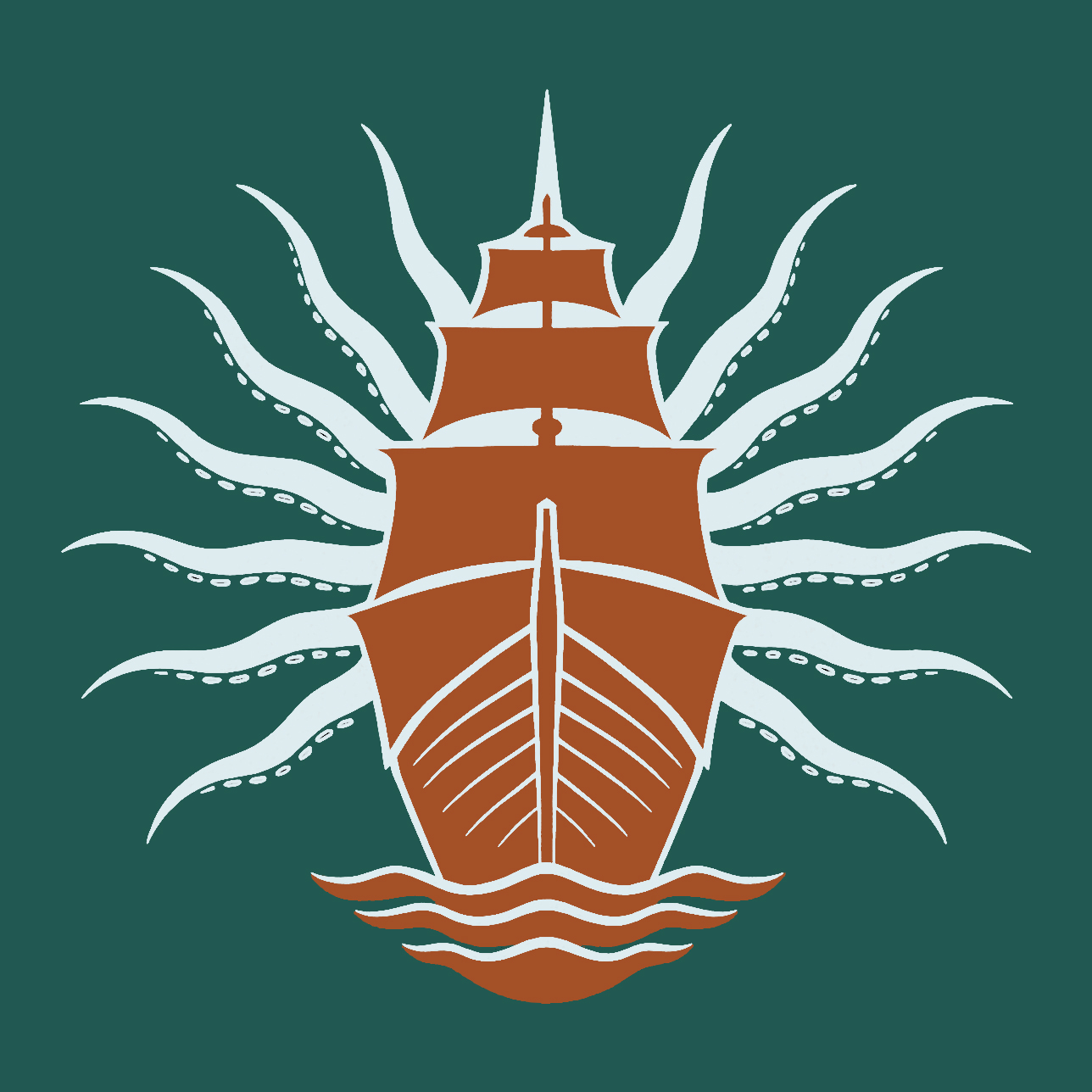
The flag of Duvain consists of a copper ship-of-the-line, pointed prow forward, surrounded by fifteen silver arms of the sea. While these can stylistically change, most depictions see these arms designed as kraken-like tentacles. These represent the twelve initial merchant families that made up the Representatives Council, and the remembrance of the three Sea Lords of the House of Orange that won Duvain its freedom. Naval sailors tend to depict the ship in a dark silhouette with the tentacles in copper, representing the humble earnings of the free commoner, while higher-ranking naval officials opt for retaining the silver colouration. While the colour of the flag is most commonly teal, Duvain’s heraldry can be displayed in the many other hues of the seas themselves, such as turquoise, aquamarine, deep blue, and even seafoam green.
Government and Politics
In its initial independence, Duvain was, for three short years, overseen by members of the House of Orange; the by all accounts ‘pirates’ that helped free the once-colony from Berphauntian rule. However, after purportedly seeking to convince the people to take the reins of all the seas of Maud’madir as their own, twelve merchant houses rose to politely, if firmly, oust the House of Orange from office. The Representatives Council which formed on that day continues to rule over Duvain as a democratic republic in the eyes of major politics, though some citizens and outside political inquirers claim it to be a ‘poorly disguised’ oligarchy. Despite these misgivings, Duvain prides itself on being a multicultural melting pot of many races and creeds, all under the canopy of merit solely through one’s successes in their profession. In short, the common Duvainian seeks to never again be ruled by a hereditary monarch.
The Representatives Council
Known colloquially amongst the Duvainian people as the “Council of Twelve” or “Ruling Council,” this governing body was composed of the twelve most profitable merchant houses of the previous year. In 2267, this number was reduced to ten by the order of First Sea Lord Leora Fraley. Each Councillor bearing a seat is the current head of the merchant house in question. From among the remaining merchant houses not present on the council, a Chief Spokesperson is elected to both serve as speaker within the capitol, and public relations to the greater republic. Each household on the council is considered to be of High Nobility until such a time as they are replaced by another house. The Chief Spokesperson is also considered High Nobility during their time serving the council.
The Representatives Council at its inception consisted of the following Councillors and Chief Spokesperson:
- Lord Paddington Bottlesworth, House Bottlesworth
- Lady Durienne Mistbloom, House Mistbloom
- Lord John Blackthorne, House Blackthorne
- Lady Marelle Dunlop, House Dunlop
- Lady Arabelle Silverskin, House Silverskin, Lightweaver of Abacus
- Lady Mary White, House White, Heiress to the House of Shurehound
- Noble Aragano Lynch, House Lynch
- Lord Candidé Gomorrah, House Gomorrah, Heir to the House of Gran Belle of Day’ten
- Lord Norbert Figbottom, House Figbottom, Head of Wessledally Manor in Teris
- Lord Dayton Beachhead, House Beachhead
- Lady Longo Peapodder, House Peapodder
- Lord Thran Lytton, House Lytton
- Harold Witt, House Witt, Chief Spokesperson of Duvain
By 2256, the Representatives Council experienced a major shift of political power, with all but one household—House Gomorrah—losing their seats to other up-and-coming merchants. These new households were the Houses of Vintner, Curum, Bantry, Urquhart, Wainright, Hafdrasill, Von Blücher, Fiennes, Thynne, Cholmondeley, and Fraley. The Councillors and Chief Spokesperson were as follows:
- Lord Candidé Gomorrah, House Gomorrah, Heir to the House of Gran Belle of Day’ten
- Lord Regis Aiogrin Vintner, House Vintner
- Lord Alphonse Curum, House Curum
- Lady Victress Bantry, House Bantry
- Lord Thaddeus Urquhart I, House Urquhart, Ambassador of Duvain to the Host of Physignathus
- Lord Percival Wainright V, House Wainright
- Lady Kelda Hunhil-Hafdrasill, House Hafdrasill
- Lord Bruno Von Blücher, House Von Blücher
- Lord Figaro Fiennes, House Fiennes
- Lady Genevieve Thynne, House Thynne
- Lady-Matriarch Sevira Cholmondeley, House Cholmondeley
- Lady Amelie Fraley, House Fraley
- Henrietta Fletcher, House Fletcher, Chief Spokesperson of Duvain
After the Hell King’s War of 2267, with the majority of the Councillors and naval command slain, First Sea Lord Leora Fraley assisted in the creation of a new Representatives Council, with the Chief Spokesperson being elected as Vincent Thynne, Captain of the Cog-class ship the “Seafoam.” The reduction of seats was due to many of Duvain’s former houses of merit being decimated during the war. Because of this, many citizens have begun calling it the “Tenfold Council.” A proposed diplomatic position on the council afforded to the House of Orange has been brought forward by the First Sea Lord. As of yet, the House of Orange has refused this proverbial olive branch, and the special seat remains vacant.
The House of Orange
House Head: Anton zhon Anton II, Captain of the Gullgather, Free-Commodore of the House of Orange, Ajaunti
The House of Orange were originally a clan of Ajaunti and Humans that operated a trade fleet out of the colony of Duvain under Berphauntian rule. As Berphaunt put more and more pressure on the colony, the citizens began to suffer. Indentured servitude under kingdom edicts being made commonplace, citizens rights being diminished, and underpaid labour for the working class were among some of the acts that had Duvainians convinced of Berphaunt’s cruelty in their occupation. The then head of the House of Orange, self-proclaimed Admiral Horatio Villhan, had his brethren turn to piracy to combat the woes of the people. At first they targeted the ships carrying taxes back east to Berphaunt, but swiftly moved to any Berphauntian vessel they could target on the open sea. These actions sparked the revolt and rebellion that would one day free the colony from Queen Louise Berphaunt’s rule, and into independence as a naval republic of influence.
While the House of Orange was lauded by the newly freed Duvainian people as roguish heroes of the common man, Villhan, his son Anton the First, and his cousin Belamy, only held rule over the newly established Duvain for three years as their First, Second, and Third Sea Lords; titles given to them by the grateful people for their success. Pressure from twelve wealthy merchant houses, with backing from the Greater Banks of Abacus, forced them to abandon their lofty goals of ruling a nation and return to the sea. While the newly formed Representatives Council attempted to placate Admiral Villhan and his two other Sea Lords in their heraldry, as well as make their family privateers under permanent letters of mark for their service, the sickeningly civil manner of their removal has been a chip on the shoulder of the household ever since.
While the simple amber-coloured flags of the house can still be seen flying today, the Ochre Fleet under their command rarely makes port for long, preferring to stay in open waters. The House of Orange are seen as brutal and skilled privateers under their current Free-Commodore, Anton zhon Anton II, the grandson of the original Admiral Villhan.
Social Hierarchy
Duvain’s noble-based social hierarchy is based solely on one’s profits and business acumen. As such, non-military personnel only use the titles of Lord, Lady, or Noble instead of the wide array of titles afforded to other nations. However, the free citizens of Duvain not belonging to a noble family value craftsmanship and personal freedoms above all else. The common person’s worth to society by their peers is dictated by their skill in a legal and honest trade.
In terms of the Duvainian Navy, acts of heroism to the Republic and mastery of the waves are seen as the biggest asset to one’s social standing.
The overall social hierarchy is as follows:
- The Councillors of the Representatives Council
- The Nine Sea Lords of the Navy
- The High Nobility
- The Lesser Nobility/Commanders of the Navy
- Officers of the Navy
- Free Citizens
High Laws
The High Laws of Duvain, which are overarching laws that set the spirit of governance for all other settlements under the Republic, are as follows:
1. To attain the privileges of a Duvainian citizen, and thus Duvainian High Law, one must either be born of a High Noble House, attain a temporary Writ of Protection from a local official of the settlement the individual resides in, or attain a Writ of Citizenship from a representative of a High Noble House. In certain settlements, a Writ of Citizenship may be given by the representative of a Lesser Noble House, though this is decided by the local government.
2. All races, creeds, and faiths are welcome within the Republic of Duvain, and their practices, both cultural and religious, are protected so long as they remain Duvainian citizens. As caveat, such practices must still adhere to Duvainian High Law and cannot endanger Duvainian life or autonomy. Interfering with such is considered High Treason.
3. Slavery is illegal within Duvain. Any slave that manages to cross into Duvain’s borders is considered to be a free person for all purposes, and is encouraged by local businesses, should they reside within a large settlement, to take up an apprenticeship to learn a trade.
4. A Duvainian citizen has the right to enter into contractual agreements free of coercion of any sort. The use of mind altering effects such as Charming magics or alchemy to subvert one’s will into making such agreements will result in such an agreement being rendered null and void. Those found guilty of such unethical business dealings may lose office, title, or trade contracts, and in some cases be required to pay a sizable fine to the coerced.
5. The following magics and items are deemed illegal in Republic lands, be they utilized or sold by Duvainian citizens or foreign parties:
- Death, Slow Death, and Cindamite alchemy, including Naval-Grade Cindamite chemistry.
- Any compound or spell that causes disease, affects one’s mind, or forces compulsion of the truth as understood by the recipient, save for Hallucinoid alchemy.
- Garrotte wires and Stiletto knives.
- The Spheres of Light, Dark, Necromancy, and Wytchcraft.
6. A Writ of Use can be purchased from a representative of a High Noble House—at their discretion—for any of the above illegal magics or items, reclassifying them in such a case as ‘restricted.’ The following are exceptions and specific amendments to the above 5th High Law:
- Naval-Grade Cindamite has a specific Writ of Use only given to special military personnel; never for common citizens. Possession or use of Naval-Grade Cindamite without military permission is considered Treason.
- Forget and Feeblemind alchemy are prohibited without exception.
- The Sphere of Wytchcraft is prohibited without exception.
- The Sphere of Necromancy is usually reserved for religious practices or for specific study within the Republic Arcanist Collective. All applications for Writs of Use for Necromancy must go through the Republic Arcanist Collective, and require either religious or scholarly explanation with a high level of scrutiny.
- The Sphere of Dark granted by the God Erasmus may qualify to have any fee involved in its Writ of Use waived by the Church of Erasmus.
Noble Houses
The noble houses of Duvain are colloquially known as the Great Houses. While the ten members of the newly reformed Representatives Council are the current High Nobility of the Republic of Duvain, even former seated members of the council continue to be Lesser Nobility unless they become utterly copperless, socially disgraced, or otherwise fade from history. The current ruling noble houses are as follows:
House Vintner
House Head: Lady Siobhán Vintner, Wood Fae
A household of Wood Fae which has taken a strong approach to becoming Duvain’s largest supplier of alchemy, herbal products, and the alcohol that the Republic consumes. It is said they have a larger history of privateering for the Republic in its younger days, but this remains a dockside rumour at best. Since the death of their house head and torching of several of their vineyards by demonic hellfire in late 2267, the household hangs by threads to its glory days of wine production. They now try to anchor themselves firmly as alchemical suppliers to the free citizens of Duvain until such a time as their liquor production can recover.
House Curum
House Head: Lord Giacomo Curum, Human
A household of native Humans to the island which quickly became the number one supplier of raw materials to the Republic. This monopoly over Duvain’s long history has allowed them to bring some of the finest craftspeople under their umbrella of influence, making a concerted attempt to corner the luxury goods market.
House Vendrech
House Head: Lord Heinrich Von Bestilgoff-Vendrech, Human
A household of Humans that specialize in lavish clothing for the wealthy. Once an independent house in western Bakura, they moved to Duvain in 2260 to bring their unique brand of style to the island nation. To assist their transition to the council, the Vendrech family entered formal business dealings with the minor textile and furniture houses of Shurehound and Tomei. With the near complete destruction of House Thynne during the Hell King’s War of 2267, House Vendrech seems to have filled the void left by Thynne’s now closed haberdasheries and dress shops, establishing clothing stores of note all across Avanelle.
House Urquhart
House Head: Lord Nithe Draganević Urquhart III, Human
One of the oldest households of Duvain. Their specialties are of a magical variety and over the last thirty years have earned their coin writing scrolls for the Republic Arcanist Collective; the bureaucratic Mages Guild of the Republic. While many of the house’s Battle Mages fell in combat against the legions of Hell in late 2267, their fierce devotion to the Dragon Physignathus saw them through to surviving the conflict. They continue to be stewards of the waters, working in tandem with the Host of Physignathus while out on sailing endeavours.
House Gwindengould
House Head: Lord J’oliboc Gwindengould Jr., Paragon-Banker 3rd Class of the Church of Erasmus, Hobling
After the Hell King’s War of 2267, much of the buyable property in Avanelle was in shambles, due to great conflagrations set by the Demons. Though many insurance claims went through to the Church of Erasmus in the city’s business district, hundreds more were unable to be claimed due to insufficient familial signees remaining alive after the destruction. The House of Gwindengould capitalized on this, gaining property at an alarming rate by utilizing asset-seizing clauses left and right. Absorbing the remainder of House Wainright into their ranks, House Gwindengould has now become the common Duvainian’s premiere money lender and property seller via the Church of Erasmus. J’oliboc Gwindengould Jr. is now the youngest, yet arguably most cutthroat, member on the council at only 21 years old, with many calling the teenager a “merchant lord prodigy.”
House Cholmondeley
House Head: Lord Vivaan Cholmondeley, Savar’Aving
This house has a majority control of the fishing industry and whaling in the nation’s waters, founded by a group of Savar’Aving settlers. Providing a large share of their hauls at the local markets as well as the alchemical reagents found in whales quickly allowed them to sit comfortably on the council for many years. With the death of their house matriarch Sevira Cholmondeley in late 2267 and pressure from House Urquhart via Physignathus’ sacred laws of the sea, their whaling activities have dwindled in favour of pearl diving under their new house head Vivaan.
House Von Blücher
House Head: Lord Reinveldt Von Blücher, Mountain Dwarf
Originating from the Altheahean mountains of Gerdain, this noble house focuses on the import of exotic metals from the city of Dolgerhan. Von Blücher-made armaments are some of the most sought after in the markets of Avanelle, and seeing them shipped abroad is a rarity. The Duvainian Navy has several contracts with the household to supply their troops, as well as wrought-iron ammunition for their naval cannons.
House Fiennes
House Head: Noble Fortiste “The Miraculous” Fiennes, Human
House Fiennes is best known for building homes for the free citizens and nobility in equal measure. From simple wood and stonework to lavish manors of expert craftsmanship, the architects and builders of this household have done it all. With the devastation to Avanelle after the Hell King’s War, the youngest child of their late patriarch Agam Fiennes took to reclaiming lost revenue by a ‘charitable’ act. Dubbed Fortiste “The Miraculous” by the commoners due to the incredibly reduced pricing they imposed for simple home rebuilds, the young Noble garnered enough coin to retain their seat on the council in short order.
House Wysangost
House Heads: Lord Sohtor Wysangost, Carnal Fae and Lady Del’Aoife Bleakmeadow, Night Sidhe
The talk of the Republic’s fashion district has had little to do with garments as of 2268. With the repopulation of the Representatives Council, a newly created noble house made waves immediately by providing the people a means to feel beautiful even in times of chaos and uncertainty. House Wysangost is known for its affordable yet extraordinarily unique fragrances and other beauty products. Lead in tandem by its young couple, a mysteriously debonair Carnal Fae by the name of Sohtor and his betrothed, Del’Aoife the Sidhe, rumour has swirled amongst the impressionable youth of the Republic as much as the older trendsetters in Avanelle. Some claim Sohtor has connections to a faraway group of secretive Carnal Fae merchant lords, while others spread gossip that his bride-to-be was once Winter Court royalty. Members of the house tend to be Humans and High Elves, who dismiss as many bits of this hearsay as they do give out free samples to the working class.
House Rakuda
House Head: Lord Kurtzwyle Rakuda, Trademonger Supreme of the Rakuda Syndicate, Goblin
Desperate times call for desperate measures, as the saying goes. The newest addition to the Representatives Council, House Rakuda, are extreme examples of such. After the demonic attack on Avanelle, it was not only its docks that were obliterated, but almost all its drydocks and shipyards as well. With the shipbuilders of House Hafdrasill either returned to Clan Hunhil or dead, Duvain was lacking in the ability to recreate its naval vessels with any expediency. Enter the Goblin Rakuda Syndicate, or as their Lord Kurtzwyle insists now, “the Glorious House of Rakuda.” Once a renowned crime family operating out of Avanelle’s underground, the House of Rakuda now claims to have found its “patriotic spirit” after the war. Home to a massive workforce of over five hundred Goblin carpenters, lumberworkers, loggers, and shipwrights, they have signed a lucrative contract to aid military shipbuilders in their restoration efforts, securing them a seat on the council.
Former Noble Houses
The Republic House of Records bears little information as to the specific business types of in the founding council’s households. However, such information is still widely available on the Great Houses that once held positions on the most recent iteration of the council before its reformation by First Sea Lord Fraley in early 2268. These once Great Houses are as follows:
House Gomorrah
House Head: Unknown
A house of Deminis’Thalan, or High Elves, which started their road to riches selling fine metals and arcane luxuries to the people of Duvain. From 2237 to 2267, their focus shifted from the fine and magical to the mass produced. Many products used in the everyday life of Duvain have the stamp of House Gomorrah on it, be it tableware or the clothes of the working class. Most of the mundane objects used in everyday life once fed their coffers. With the murder of the elderly Lord Candidé Gomorrah on July 18th, 2267, House Gomorrah fell into disarray. While the family estate slowly falls to disuse, none are sure where the former house head’s granddaughter now roams, or even if the house shall ever recover.
House Bantry
House Head: Unknown
Where all the other council houses traded in goods or coins, the Human-led House Bantry dealt in death. This renowned Duvainian mercenary house focused on the training and lending of highly proficient ground forces with a specialization in scouting and skirmishing warfare. After the Hell King’s War of 2267, the house lost a grand majority of its mercenaries to the war effort. While honoured by the Duvainian people, the house has disbanded after decades of existence, with the few remaining mercenaries seeking other organizations for employment.
House Wainright
House Head: Lord Revington Wainright, Human
The House of Wainright was known for their specialization in money lending, and providing startup funds to Lesser Houses of Duvain at an usurious interest rate. To save reputation after the Hell King’s War of 2267, a surviving grandson of the Wainrights, Lord Revington, signed over the family’s remaining assets to the Hobling-run House of Gwindengould.
House Hafdrasill
House Head: Unknown
Once a band of enterprising Einher, this noble house came from Mjoll as part of a Clan Hunhil raiding party. Through generations of marriage, the Einish members of the house were joined by Duvainian Humans. This house’s specialty was the construction and sale of fine ships, which quickly earned them a spot on the council in 2256. However, they have since disbanded in 2267, with the remaining Clan Hunhil Einher sailing back to the north to once again join their united kin under High Chieftainess Revna Mothersblood.
House Thynne
House Head: Unknown; Position refused by Captain Vincent Thynne, Chief Spokesperson of Duvain, Human
This house had a focus on lavish fabrics, textiles, and clothing. While House Gomorrah may have had a monopoly on the clothes of the common worker, House Thynne cornered the market on clothing for the wealthy and elite. The household took the brunt of the damage from the demonic incursion of Avanelle on July 18th, 2267, with almost all the primary family being slaughtered by the hellish creatures.
House Fraley
House Head: Lady Mirria Amelie Fraley, Human
The House of Fraley focuses on the import and resale of building materials needed for the construction of housing in Duvain that is not found on the island itself. To ensure the safety of their seat on the council in 2260, they started branching out to rarer and more exotic lumber. While the household survived the Hell King’s War of 2267, they did not return to sit upon the Representatives Council. With the young daughter of the house, Leora, serving as First Sea Lord, House Fraley willingly stepped down from their council seat to more directly assist the military in helping the common free citizens of Duvain during its restoration efforts.
Lesser Nobility
Lesser Nobility in the Republic of Duvain can be purchased for 100,000 gold coins, payable to the Republic House of Records in the business district. Paying this fee entitles an individual to start a noble house, grant free citizens their familial name as a show of allegiance to the household, and compete in profit for a seat on the Representatives Council.
Military
Organization and Forces
Duvain’s military is firmly water-based, and as such the Duvainian Navy is the only military organization sanctioned by the Representatives Council. While naval service was compulsory in the Republic’s early years due to the threat of potential Berphauntian retaliation, the practice was soon abolished.
Before July 2267, Duvain’s naval might was unmatched. Its massive fleet of ships, bolstered by privateers, was the absolute might of the seas. Neither the Royal Navies of Tiefanue or Berphaunt were able to match their sheer skill on the waves. Even after the Kingdom of Berphaunt elevated to an empire under Emperor Louis Berphaunt, the Imperial Navy did not dare go prow-to-prow with Duvain’s mighty armada of vessels without significant numerical advantage on their side.
However, after the Hell King’s War, Duvain lost much of its great navy to the unending tides of Demons, including its naval command. Ranks from Commodore to Lieutenant were lost in but an instant, causing a significant upheaval amongst the military. As of April 2268, the newly appointed Sea Lords, under First Sea Lord Leora Fraley, have reassembled the chain of command within the navy, and efforts are underway to restore Duvain’s military to its full strength. Though morale is high, the knowledge of how much was lost still clings to the common man heavily, and shrines of remembrance to the fallen dot both military institutions and reassembled piers across the port district.
The Sea Lords
The nine Sea Lords of Duvain are the absolute heads of the Duvainian Navy, acting as a colourful and unique admiralty. They collectively have complete control over Duvain’s naval might during times of war, and if such conflict reaches Duvainian waters, the Sea Lords have the power to overrule even the Representatives Council.
Up until early 2267, the First Sea Lord was William Monroe, a man of common birth who joined the Duvainian Navy to escape a life of poverty. First Sea Lord Monroe shifted the navy’s focus over his 20 years of service to value naval command and skill over any bloodline lineage to powerful merchant families. This practice has continued to the present day.
The Second through Ninth Sea Lords answer to the First Sea Lord for purposes of organization, counsel, and deployment of necessary military vessels. In the truest Duvainian fashion, the election of the First Sea Lord was traditionally decided by the Sea Lord who owned the most ships and had the most crew sworn to them. This harkens back to the days of the House of Orange’s rebellion and their three Sea Lords, with the belief that the one who would be able to capture the most enemy ships and recruit the most sailors deserved glory equal to their plunder. In the modern day, the Sea Lords are chosen by valor, military muscle, and charismatic presence, returning them in many ways to the freedom-seeking pirates that won Duvain’s independence. As of June 2268 the nine Sea Lords have been collectively rallying the Duvainian people to continue forward into the uncertain future, with many seeing them as the true powers of the Republic due to their hand in reordering the new Representatives Council.
The common free citizen views the Sea Lords as the real guiding hands of Duvain, rather than the council of wealthy nobles at its head. Young children see the Sea Lords as legendary figures to aspire to; mastering the winds and waves to keep the people of the Republic safe while ever seeking the next adventure.
As of early 2268, the Sea Lords are:
- First Sea Lord Leora Fraley, Captain of the Verdict’s Grace
- Second Sea Lord Ginifred “Gin” Castle, Captain of the Galeprince
- Third Sea Lord Jacque “The Firmament” Azurebolt, Arch-Atmomancer of the League of Atmomancy, Captain of the Sparking Pearl
- Fourth Sea Lord Jonathan Raisport, Captain of the Remembrance
- Fifth Sea Lord Gwyndolin Braeggrim, Captain of the Ghost
- Sixth Sea Lord Barnum “Sharkbite” Ramsey, Captain of the Belligerent
- Seventh Sea Lord “Suave” Dravish Fitzroy, Captain of the Coiling Orchid
- Eighth Sea Lord Hargrand Swiftspindle, Captain of the Water Strider
- Ninth Sea Lord Solarius “Ol’ Sol” Goldwyn, Captain of the Dauntless Morning
Awards and Honours
Duvain has several military decorations awarded to both citizens and naval personnel alike for actions befitting the Republic. Each is a medal, usually given with an included citation, briefly describing the actions the individual is being awarded for, and may even be given posthumously. In addition, individuals who have earned multiple of the same award have bars added to the ribbon of the medal, denoting their exemplary acts in defense of the Duvainian people. The awards are as follows:
Anchor of the Republic
This anchor-shaped medal is awarded for: “Most conspicuous bravery, or some daring or pre-eminent act of valour or self-sacrifice, or extreme devotion to duty in the presence of the enemy.” It is reserved strictly for military action of the individual in question and is the most common award of the Republic. The post-nominal letters of ‘AR’ may be added to one’s name or title.
Wheel of Courage
This ship’s wheel-shaped medal is awarded for: “Acts of the greatest heroism or of the most conspicuous courage in circumstances of extreme danger.” It is usually awarded for military actions not engaged in direct combat, or for civilian actions that warrant praise. The post-nominal letters of ‘WC’ may be added to one’s name or title.
Guiding Light of Duvain
This ocean-shaped medal with a lighthouse emerging from it is awarded for: “An act or acts of conspicuous gallantry, or exceptional service or services to the Republic of Duvain.” While it can be used more freely than the other two in terms of its recipient, the Guiding Light of Duvain is reserved for grand acts of service to the Republic for citizens or military personnel alike. The post-nominal letters of ‘GLD’ may be added to one’s name or title.
Economy
Trade and Industry
Duvain’s main national industry, unsurprisingly, is that of trade itself. Bearing the largest fleet of merchant ships, the myriad businesses under the umbrella of the Church of Erasmus, and the sprawling Lanes of Commerce, Duvain has no shortage of materials, objects, or services that can be bought. A common phrase known amongst merchant lords from the Wasting Sea across to the Eastern Deep is “if it can’t be found in Duvain, it doesn’t exist anywhere.” This of course also refers to illicit goods on the secretive black markets of Avanelle, but never to the sale of indentured servants of any sort, as even the underbelly of Duvain demands adherence to freedom. Nations, kingdoms, and city-states from all over Maud’madir deal with Duvainian merchants on the regular, with general exception to Berphaunt’s capital specifically for historical reasons of displeasure.
Apart from merchant trade, Duvain’s other major industries include fishing and the creation of timber. The skilled fishermen of the Republic never over indulge in catches from the surrounding area, ensuring that plentiful bounties on the waters are available nearly year round. Duvainian lumber is sought after by many markets due to the lush forests present on the island, and the industriousness of Republic markets making transport of such wood a simple affair.
One of the most unique industries in Duvain is that of Naval-Grade Cindamite; the chemistry that makes ship cannons a possibility. While many water vessels of note utilize heavy ballista in their defense, true naval bombards that launch destructive spheres of iron require a special substance invented by Duvainian chemists in service to the navy. The recipe for such special Cindamite is a closely guarded secret, and its sale is prohibited without exception across even black markets due to the pressure of the Duvainian Navy’s private investigators, and the volatility of the substance. If handled even slightly incorrectly, an entire barrel of this unique Cindamite can detonate prematurely with enough force to annihilate the unfortunate ship carrying it. Each military ship that utilizes naval cannons has one or more specially-trained alchemists—known colloquially as “Cannoneers” or “Blastslicks”—whose sole job is ensuring the safety of the crew when firing the dangerous weapons.
Despite the dangers involved, powerful and influential pirates coming out of Durrigen Cove have been seen utilizing captured barrels of the effervescent gel to fire a precious few shots from reclaimed cannons. It is also rumoured that the secret of Naval-Grade Cindamite has been found out by the Empire of Berphaunt, though no citizen has ever been able to prove it.
Organizations of Note
Republic Arcanist Collective
Known for their adherence to hierarchical practices and strict mandates, the Republic Arcanist Collective is the premiere Mages Guild of Duvain. The organization is elitist and meritocratic, charged with pushing the boundaries of spellcraft for the good of Duvain’s people. The mages within its ranks focus on excessively private scholarly endeavours, and applications to be considered for membership of any appreciable rank are as rigorous as they are tedious. It is said attempting to order ritual scrolls from the organization without the proper procedure, decorum, and credentials is a process that borders on the inane. Despite this, the Magus of the collective—the most powerful spellcasters within—are seen as some of the foremost political and practical minds on magic within the Republic, with many bearing unique proprietary magical advancements in their repertoire. Their current head is Magus Publicus Administratum Eustace Golubrion Belmeister, a sagely antiquarian that resides at the Grand Arcane Spire; the sprawling headquarters of the Collective in Avanelle.
League of Atmomancy
Established in 2247 by former Republic Magus Jacque “The Firmament” Azurebolt, the League of Atmomancy is a select group of nautical mages of adventurous spirit and awe-inspiring power. Their Atmomancers—known affectionately as “Weather Warlocks” by the populace—have an almost superstar status amongst all classes in Avanelle. These specialized mages are all trained in the art of sailing, navigation, naval command, and unique applications of Elemental Magic firmly rooted in the attunements of Ice and Lightning. Each makes a pact with a powerful Water and Air Elemental using special rites held secret by their order. This allows them to have limited control of the weather itself, calling wind to windless sails, conjuring localized rainstorms to hide military operations, or even siphoning the gales from enemy ships to render them inert on the waves. In early 2266, the League has also begun dabbling in practical applications of Dredgecraft Battle Magic in tandem with their art to great success. Alongside the daring and bold depictions of the nine Sea Lords, the Atmomancers of this small yet influential organization are the only other individuals of the public that are featured in popular pulp novels as heroes or, for more adult books, romantic interests.
The League of Atmomancy has a long-standing healthy rivalry with the Republic Arcanist Collective, as Arch-Atmomancer Azurebolt believes they focus too much on their political mettle versus the potential for more grandiose acts of service to Duvain as a people. In turn, the current Magus Publicus Administratum of the Collective has stated that the League of Atmomancy “should start treating their ledgers with a level of respect equal to the ridiculous bravado present in their printed, fictitious drivel.” Despite the verbal fencing, the efforts of both organizations in tandem have been attributed to why the Duvainian Navy continues to hold dominion over the waters of Maud’madir.
The Nilbog Coalition
The self-styled ‘Nilbog Coalition’ is a loose conglomerate of highly skilled Goblin alchemists. These Goblins, obsessed with the reactions produced by alchemical interactions, tend to be extremely mercantile. When not hawking their goods and services, their members can be found pursuing new knowledge and breakthroughs in what they call ‘The Art’. While their methods and practices are often haphazard in the extreme, their nigh suicidal willingness to make use of any available ‘Juicy Bits’ and experimental apparatuses often yields impressive results. They are traditionally garbed in what they will loudly assert to be ‘protective equipment necessary for the Art’; an all-covering alchemy stained robe or cloth cover, a pair of goggles to protect from splashing liquids, and a soaked rag acting as a mouth covering to protect against inhaling condensed gases. They will accept any Goblin willing to dabble in alchemical studies as apprentices, but only those willing to specialize have any hope in ascending in its ranks. Run by a committee of chemists rumored to be called ‘The Emerald Table’, each member is hand-picked and vetted by the Chairman of the local Coalition enclave who directs the scope and direction of the committee’s research. While this may seem startlingly democratic to outsiders the truth is that the head of each Coalition enclave holds onto their position through subtle, and less than subtle, manipulation as well as rigorous information control.
Church of Erasmus
Before Erasmus rose to his place in the Dark Pantheon via the entrapment of Abacus, the God of Wealth and Finances, the three Greater Banks of Abacus dominated the trade-focused capital of Duvain. These massive vaults held gold bullion and ingots stamped in Duvainian mark, loan paperwork by the thousands, and a trained mercenary force whose sole duty was to protect the nobility’s savings held within. However, black market institutions to the godling Erasmus operated in secret out the back of avaricious businesses, inside pier-side speakeasies, and even in Avanelle’s underground sewers. A silent war between the good nature of commerce and the hunger of greed was taking place each day in the Republic.
Needless to say, when Abacus was captured and Erasmus, the benefactor of the Banker’s power, ascended to true Celestialhood, so too were Abacus’ mortal enterprises. Seemingly overnight, the Greater Banks of Abacus became the sprawling Church of Erasmus, and what was once back alley dealings in enigmatic chapels-made-markets became conglomerates of incredible size. The Church of Erasmus now holds claim over over 40 percent of Duvainian businesses, not to mention the inherited properties, owed loan repayments, and contractual dealings present in the previous religion’s vaults. The main church itself spans five large warehouses that contain hundreds of businesses sworn to the Miser, with many patrons both religious and unburdened by such concepts spending their hard-earned coin within.
Religion
The Republic of Duvain holds complete freedom of religion in its lands. No member of any government or citizen body may discriminate against a person’s religion or creeds. It is thought that to take away this right would be to spit in the face of everything Duvain stands for; a land of freefolk ruled by its citizens.
Though Duvain holds a true religious freedom, two main forms of worship and following are commonly found amongst their people. The capital of Avanelle holds the central and largest Church of Erasmus, God of Wealth and Greed, which has its virtues and vices alike extolled by many members of the Lesser Nobility. In spite of this, after the preliminary signings of the People’s Accord of Nations—the new Whiteraven Accord—in early 2268, pressure has begun to mount regarding the presence of such a Dark-aligned organization being so prevalent within Duvain’s day-to-day. As such, the church has been petitioning the burgeoning new alliance to accept significant sums of coin under the title of “gifts for the valiant deeds of the newly united kingdoms,” though as of June 2268 there has been no response from the Whiteraven Alliance on the matter.
Contrasting this, a large number of common citizens revere the Dragon Physignathus the Wavemother. These people favour hard work maintaining a sustainable relationship with the bounty of the waters over the unending need for ‘increased profits.’ Being within her dominion, many sailors find it prudent to pay respect to the ancient protector of their seas, no matter the strength of the Duvainian Navy. This relationship is returned in kind, as the Host of Physignathus used Avanelle’s ports as the staging point for the war against the Brood in 2260 and 2261. With the current weakening of the navy after the demonic incursions of 2267, many more sailors are leaning on the reverence of the aquamarine Dragon in their time of uncertainty.
Traditionally observed by sailors, naval crews, and the House of Urquhart, tribute must be given at least once annually, and must consist of at least a third of the profits of the tribute-giver’s last voyage, business endeavour, or adventure. This is typically done during the festival of High Tide in the month of June, occurring across its first week in Avanelle, and as a settlement decides, if at all, in other Duvainian ports. Local officials are responsible for making tribute on behalf of their townships, and any God followers that wish to abstain are required to pay a heavy tax to do so. While this practice is not considered a true High Law of Duvain, no Representatives Council has ever dared to go against it.
Aside from this, Duvainian sailors all take care to follow the Dragon’s three sacred laws:
- Whaling is to be prohibited. The Wavemother loves and cherishes these creatures, and will not allow them to be wastefully slaughtered by mortal hands without her direct permission.
- Sunken treasure that is in her domain is forbidden to be plundered.
- Respect the ocean and its bounty. Take what is needed, and no more. Keep the ocean clean and pure, or you risk rousing the Wavemother’s wrath.