

Am’Rath
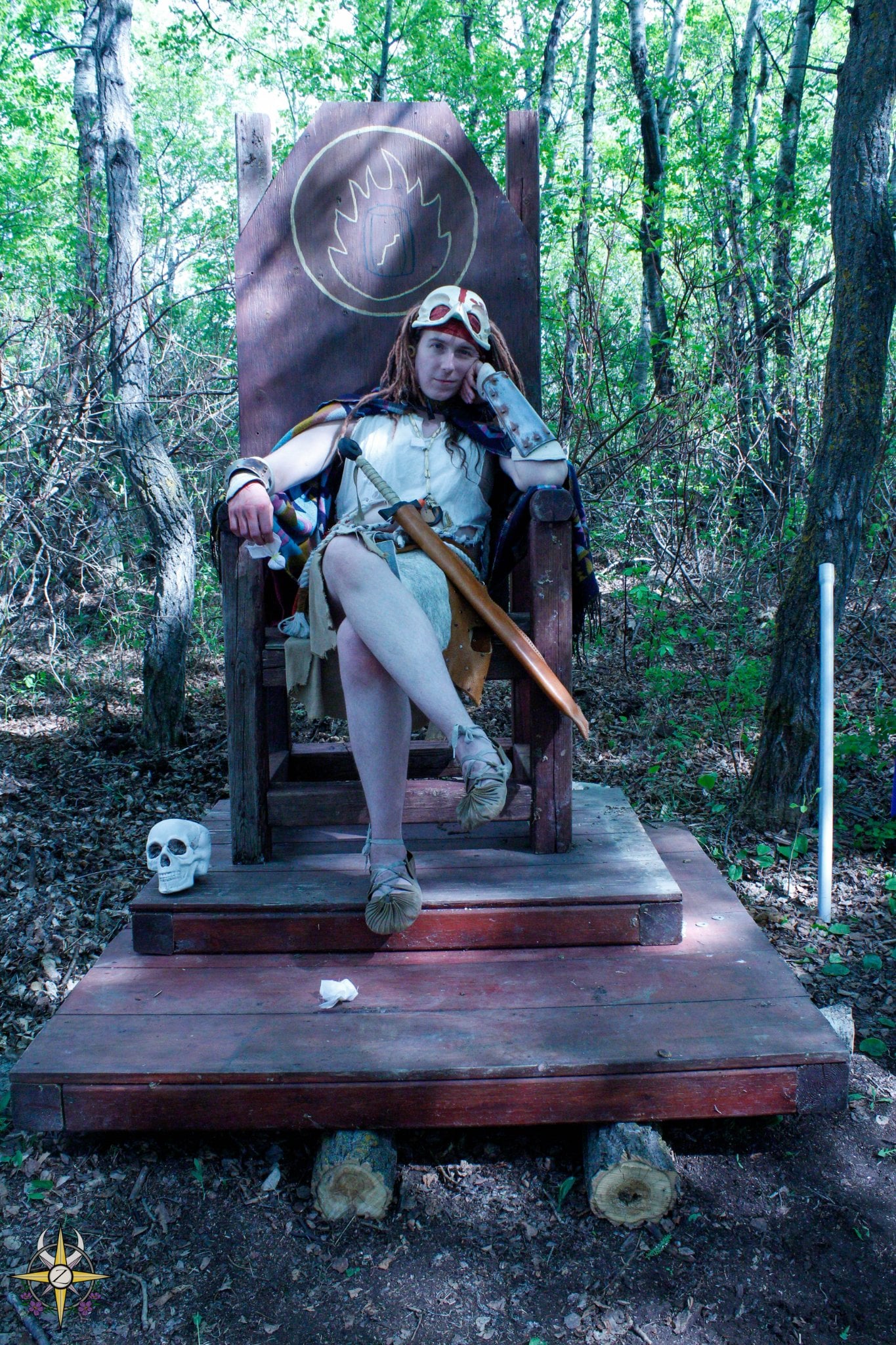
The Am’Rath are a prehistoric cave people. Unlike Wild Elves or Einher, they do not walk any sacred paths. They do not carry memory through song or honour the spirits of earth and sky. They are not bound by reverence, but by blood and dominance.
The Am’Rath represent Humanoids in their most primal and unrefined state. Originally native to the southern continent of Amaranthia, these tribal peoples have since scattered across multiple continents following a mass exodus caused by the devastating Brood invasion of their homeland.
Characterized by their fierce independence, martial prowess, and deep spiritual connection to animistic forces, the Am’Rath reject the trappings of civilization in favour of a tribal lifestyle centered around survival, combat, and immediate needs. Despite their primitive appearance and simplified language, they possess a cunning intelligence that has allowed them to thrive in hostile environments while maintaining their cultural identity for generations.
The Am’Rath are organized into numerous distinct tribes, each with specialized skills and cultural practices ranging from master hunters and trackers to feared cannibalistic raiders. Their society values physical and magical might above all else, with tribal leadership determined by combat prowess and the ability to protect one’s people. Though they maintain no permanent settlements or kingdoms, Am’Rath tribes can be found throughout the known world, often serving as mercenaries, raiders, or simply surviving on the fringes of civilized society.
Notable for their distrust of organized religion, preference for utilizing Shaman rites over formal spellcasting, and their unique pidgin dialect of Common, the Am’Rath represent an example of a people who have consciously chosen to remain unchanged by the march of civilization, viewing complexity and social structures as unnecessary burdens rather than evolutionary advantages.
Language: None (Primordial Common)
Life Expectancy: 40 – 60 years
| Child | 1 – 12 |
| Teenager | 13 – 19 |
| Young Adult | 20 – 25 |
| Mature | 26 – 30 |
| Middle Age | 31 – 39 |
| Old | 40 + |
Contents
History
 The Am’Rath are not a literate culture, and they typically do not consider or think about events more than a generation older than themselves. They are very much creatures that live in the now, with little regard for what may have come before. Thus, what little is known of the history of the Am’Rath race is composed of information gathered by the other mortal races.
Indeed, the very name “Am’Rath” was given to them by Human scholars. The Am’Rath themselves do not have, nor do they need, a word to describe the collective whole of their race. Most Am’Rath will identify as whatever tribe they happen to belong to. For example, an Am’Rath of the Redfist tribe will call themselves a Redfist, and likely be confused by anyone trying to ask them what they are beyond that.
The name Am’Rath comes from the southern continent of Amaranthia, where they first emerged in an age still shrouded by myth and legend. Beyond the occasional conflict or raid remembered by Goblinoid oral traditions or Gnomish written records, little is actually known about the tribes of primeval Humanoids that roamed that brutal land. That is, little is unknown until the Firstborn Shiloth involved herself in their development.
She saw something within them; a potential that could be nourished, shepherded, and directed in accordance with her will and designs. The Dragon began interbreeding with the Am’Rath, and over successive generations their minds expanded as their physical prowess diminished. They were in awe of their “Black Scale Totem” who taught them powerful magic, devious alchemy, and most importantly, stealth and strategy. Over time, a cunning and powerful leader rose above the rest. His name was Berphaunt, and in service to his scaled queen he forged a kingdom and drowned the continent in blood.
But not all were enamoured with Shiloth’s promises. Simple as they were, they saw the deceit that lay behind her every word and fled. As Berphaunt’s armies ravaged Amaranthia, these rogue tribes continued their ways of life as best as they could on the frontier. Over time, they watched as those who served Shiloth became another offshoot of the Human race; seen as their ferocity being replaced by poisoned tongues that whispered naught but lies and deceit. Many saw the writing on the wall, and fled the continent upon simple watercraft rather than face the incredible might of Berphaunt’s kingdom. Those that stayed were forced to live in a rather harsh existence, which would only get worse as the Brood made landfall upon their shores decades later. Those Am’Rath that remained were either wiped out, or learned to hide well enough to avoid the Brood patrols to survive.
When the Am’Rath arrived on Maud’madir, their basic canoes meant that most of the so-called “fleet” had long since been scattered in small bands by weather conditions. Those that survived settled on all corners of the continent, and after a short adjustment period they continued their lives just as they had on Amaranthia. Eventually, most of them forgot their exodus entirely; it wasn’t really all that important to them.
Those that remained on Amaranthia meanwhile, have not forgotten. They nurse a powerful hatred for all things Brood, and have allied with the nascent Amaranthine Legion in their efforts to purge the continent of that insectoid menace, once and for all.
Geography
The Am’Rath have no kingdoms, no cities, and their homeland was ravaged by the Brood for decades. As such, they have since migrated and spread across Arthos, settling wherever they could claim enough territory for their tribe to survive. The shattered island of Kalidor and the Wild Lands north of Berphaunt lay claim to the largest Am’Rath populations, but smaller tribes can be found far and wide. These tribes rarely get along with the more civilized folk of Arthos, although some nations like Teris have cannily channeled nearby Am’Rath tribes against more hostile foes by essentially opening up their larders. Berphaunt refuses to lower itself to such practices, and as such its defenses are often tested by roving Am’Rath warbands looking for loot and plunder.
Typically, a tribe of Am’Rath will settle down somewhere with access to fresh water and some sort of food source, and at least half a day’s walk from any sizable settlement. Beyond that, Am’Rath settlements vary wildly. Some have grown into well-established and even somewhat developed villages, while others are merely a collection of tents next to a lake.
Culture
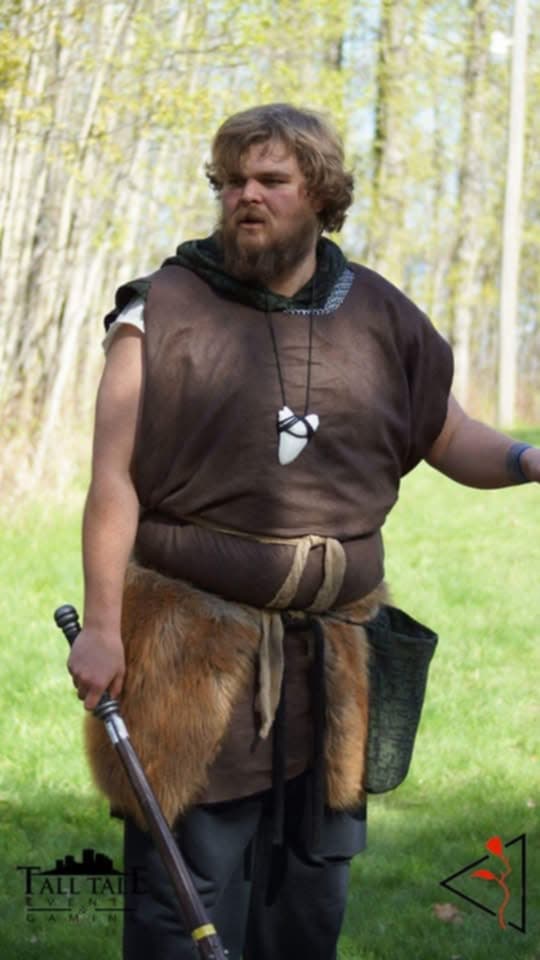 Many folk who meet an Am’Rath for the first time make the same mistake. They see their simple dress, hear their crude pidgin form of the Common tongue, and see the lack of the traditional elements of civilization around them, and jump to the assumption that they are a stupid people. Nothing could be further from the truth. They are simply a race of folk who found their niche, and then saw no reason to go beyond what they are. Unlike the Wild Elves who despise civilization for its despoiling effects on nature, the Am’Rath avoid it simply because they think it’s unnecessary and stupid. Having laws is pointless when you have a strong chief, spending years building a house is dumb when a tent will keep the rain off of you, and so on. Why would you move to a town, so far away from the plentiful food and water that is easily found in nature? Coins especially confound them, as they cannot understand why other folk value these small pieces of soft metal above things that are actually useful, like weapons and food. They understand their purpose well enough to trade, but still can hardly believe that anyone will take them.
Am’Rath society is tribal, and has remained so for centuries. Most tribes are ruled by a Chieftain and advised by a Shaman, who is often the only caster in the tribe. Might, whether it be physical or arcane, is the highest virtue in Am’Rath society as their existence is marked by constant violence. Those rare few who practise the healing arts, be it magical or other means, enable this violence and thus enjoy a special sort of privilege that places them outside their primitive caste system. Aside from their elders and their youngest children, healers are some of the few Am’Rath who are not expected to fight if they do not wish to do so, and instead can expect others to fight for them in their stead. They can also expect that they will not need to hunt or forage, as food will be provided to them as benefits to their status.
Outside of this one exception, the more martially-capable Am’Rath within a tribe enjoy better food, more freedom, and higher status. As such, the Chief of a tribe is always the most deadly warrior of that group. For as long as they can hold their position life is good, but also ruled by strife. They must constantly be ready to fend off challengers to their position, especially in times of hardship; the Chief is the first to be blamed if calamity falls upon the tribe after all.
Am’Rath live in the moment, with most of their actions directed towards meeting their immediate needs. While few Am’Rath are masters of a craft, some will at least know a handful of things that relate to the survival of their tribe. Their work, while serviceable, is often inferior to the goods produced by the other mortal races. Few simply have the time or inclination to shift their focus away from marital pursuits to really become skilled craftspeople. They have very few scruples when it comes to survival, and most have no compunctions against engaging in cannibalism or raiding others for supplies. While most Am’Rath are aware of and fearful of their immediate dead ancestors, they care little for the past beyond that.
Religion and Superstition
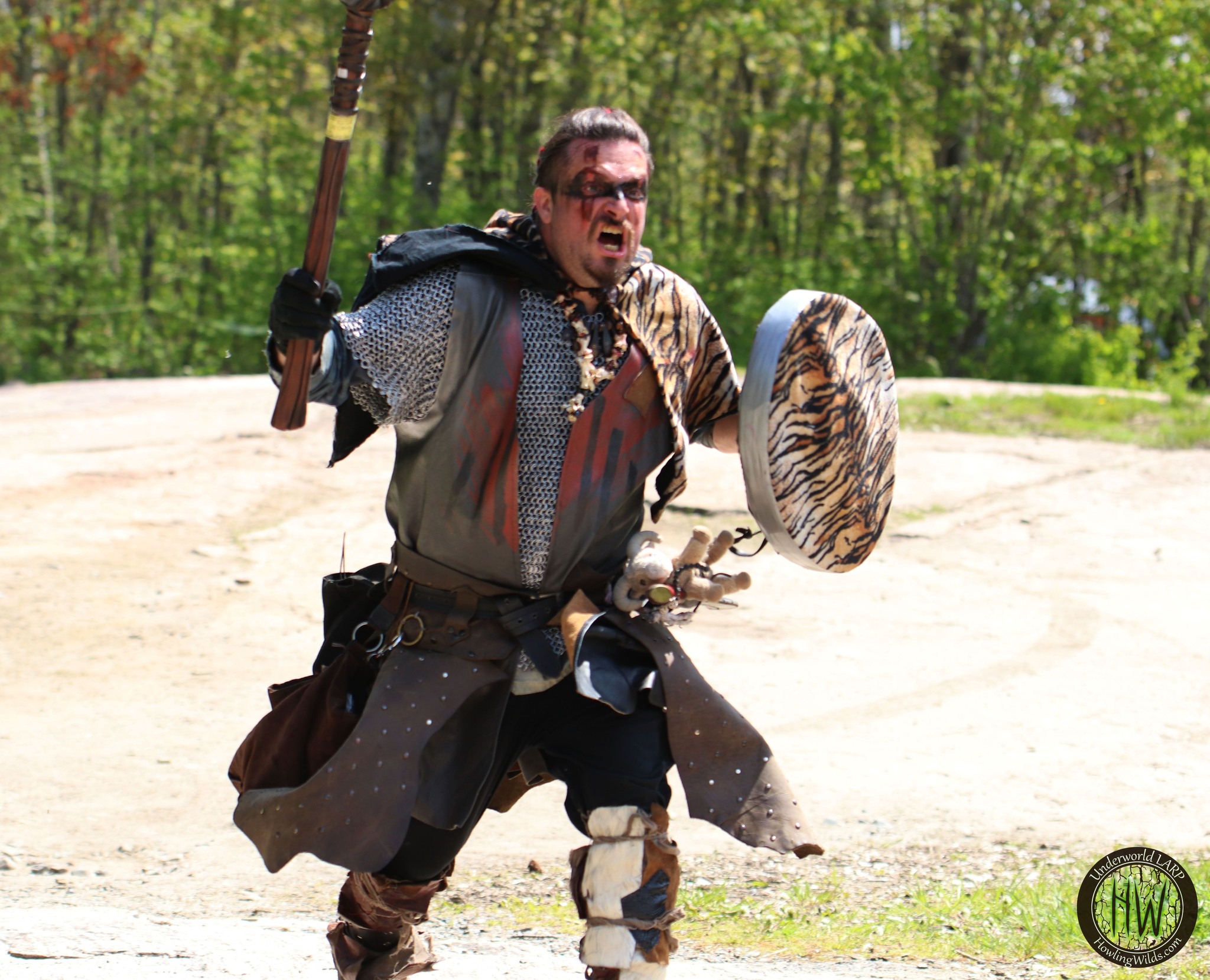 Regardless of whatever being an individual Am’Rath might believe in or follow, nearly every Am’Rath believes in a massive collection of unseen spirits. These spirits do not have names or spheres of influence like the Gods or the Firstborn, but their power is made apparent in all things. These spirits are responsible for everything imperceptible, the workings of magic being perhaps the most obvious example. If say a High Elf tried to explain to a Am’Rath mage that when they hurled fire from their palms, what they were doing was using mana to open a portal to the Elemental Plane of Fire, and using that mana to direct that fire along a path towards their target, all they would likely get in return would be an empty, confused gaze. That, or the Am’Rath laughing and calling the “Sharp-Ear” an idiot for not knowing how the spirits work. When an Am’Rath uses magic, they believe that they are speaking to these unseen spirits directly in their language, and these spirits are what makes the magic happen. The magic practised by trained Shamans is seen as essentially the same thing as spellcasting, although it is far more common than arcane magic amongst the tribes. In fact, most tribal advisors tend to be these Shamans, with their Braid nearly always composed of the Chieftain and their mightiest warriors.
With regards to Gods, many Am’Rath do not pay them much heed, or when they do it is in a derogatory fashion. Most Am’Rath bristle at the thought of being enslaved to a “Sky-Chief,” and are far more concerned with their daily struggle to survive. Just adding more rules that make their lives more difficult on top of having to listen to someone that’s not the Chief, is simply a nonstarter for most, but not all, Am’Rath. Some Am’Rath do desire the power of the Gods enough to surmount their people’s independent streak, while others simply feel that what their God asks of them is how they already wish to live regardless.
The Firstborn are not viewed in the same light as the Gods however, and their reverence is far more common amongst the Am’Rath. Following one of the Dragons is seen as petitioning an extremely powerful totem spirit for power, and many Firstborn have more primal natures that better sync with the uncivilized Am’Rath tribes. This relationship is viewed in much the same way as a druid might accept the spirit of a bear within them, and become stronger for it.
Reverence of Shiloth is completely unheard of, but not for the reasons one might expect. Even amongst the Am’Rath that still remain on Amaranthia, none remember how Shiloth used their ancestors as breeding stock, nor would they really care if you told them. Instead, they refuse to follow Shiloth because she is antithetical to their very nature. Am’Rath are direct, blunt, and honest. Everything she is not.
Marriage & Mating
Like many aspects of civilization, marriage as an institution or cultural practice does not exist amongst the Am’Rath. When two Am’Rath are attracted to each other and wish to mate, they do so. This can take the form of everything from a one night fling, to long term coupling that lasts decades. The Am’Rath are as capable of love and desire as much as any mortal race, they just don’t have centuries of law and custom that govern what is acceptable and permitted. Gender especially has no bearing upon with whom, and how they mate. Their casual attitudes towards sex and intimacy are often quite shocking to those folk who possess refined mannerisms.
Children and their care is generally a communal endeavour, with parents rarely assuming sole stewardship over their children. All of their needs are met by the tribe at large, with food, shelter, and other care provided by whomever is available and has enough extra supplies at the time. Once they are able to contribute to the tribe, they are expected to do so. The lucky ones will show a particular aptitude for a certain trade or skill, and be trained in that matter by the most skilled member of the tribe in what interests them. The unlucky ones spend their days digging shitting holes and cleaning up after livestock, or they go hungry.
Politics and Tribes
These are but some of the various Am’Rath tribes found throughout Arthos. They are a diverse and scattered people, and these do not represent the fullest extent of their cultures.
Greenmane
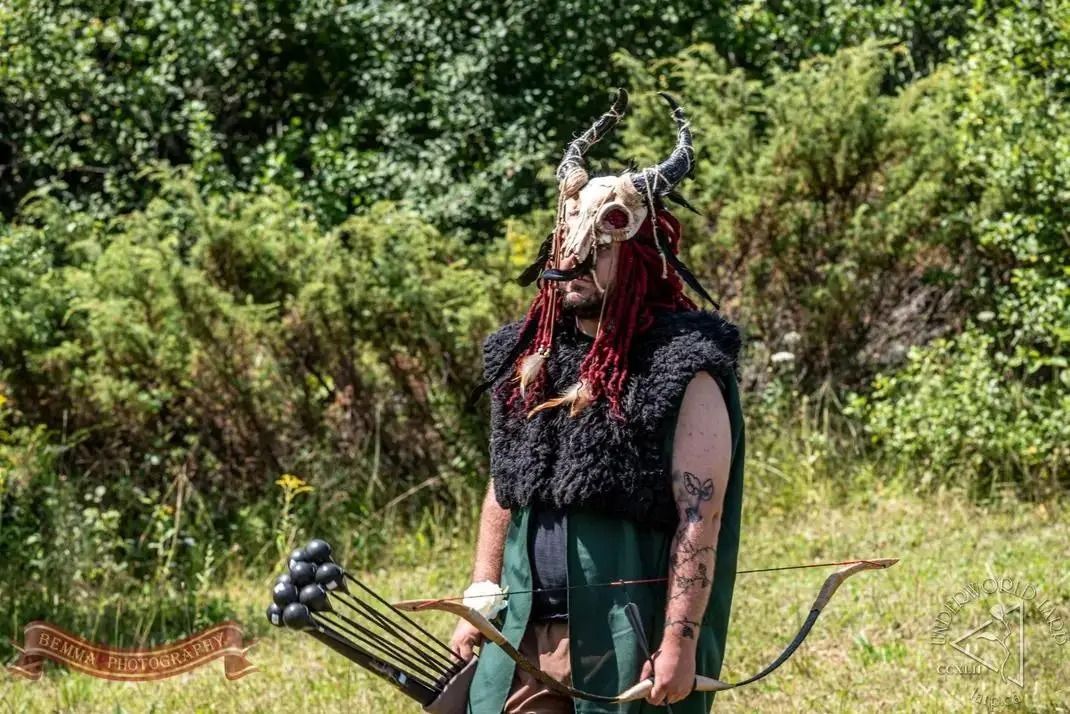
The Greenmane have molded themselves into such skilled hunters and trackers that they are occasionally mistaken for Wild Elves at a distance. They have mastered the bow and the spear, the art of tracking game through the brush, and the skill of staying unseen amongst the foliage. In order to blend in further they dye their hair green at a very young age, and after a significant hunt their Shaman or Chieftain may permit the Greenmane to mark the kill with a braid in their hair. This is often decorated with shells, beads, or even a trophy from their prey. Fae are often the target of these hunts, as they are believed to be bad omens and irredeemably evil spirits. Greenmane will thus often be in possession of iron charms, weapons, and arrows, which they refer to as ‘spirit metal.’
They live simpler than most Am’Rath and do not often trade with the other races, as they take most of what they need from the forest. Few Greenmane ever become mages, as trafficking with the spirits is seen as incredibly reckless and dangerous, with most preferring to stick to their bows for protection. The few that do use magic tend to blend their spells with other crafts, such as the arts of wytch hunters and druids.
However, just because they live like Wild Elves doesn’t mean that they get along with them. They often fight for dominance or territory, with the Elves having little respect for what they refer to as: “Foul-smelling primal-folk aping their noble culture.” The Greenmane also especially despise the Dwarves, who are often guilty of polluting their water sources with forge runoffs or redirecting the streams entirely. Any Dwarf that must travel through Greenmane territory should do so quickly.
Redfist
The Redfist are poor hunters, terrible smiths, and most cannot even manage a simple cantrip when it comes to arcane matters. The one advantage they have as a tribe is numbers. For reasons unknown to them, Redfist Am’Rath are especially fruitful, and their villages are constantly filled with the sounds of tiny running feet.
The Redfist have turned what would otherwise be a great deal of pressure on their food supplies into an asset, by forming their tribes into small armies, which they then hire out as powerful mercenaries. Through years of trial and error, they have learned how to negotiate with the other races, and these mercenaries bring back food and supplies that help the tribe survive yet another winter.
When a young Redfist becomes a teenager, they are told to put aside their toys and assigned as a thrall to an adult Am’Rath warrior by the Chieftain of their tribe. This adult is responsible for teaching them how to fight, how to negotiate contracts, and everything else they will need to know as a mercenary. In exchange, they do all the grunt work that their teacher cannot be bothered with. With each kill they wash their dominant hand in their kill’s blood, never washing this hand. Once the blood permanently stains the hand a deep red and cannot be washed off, they are considered an adult warrior and have earned their freedom back.
Blue Arm
Not all of the Am’Rath abandoned their nautical ways after fleeing the Brood, and the Am’Rath that became the Blue Arms kept to the coastlines while the other tribes moved inland. Over time the Blue Arms developed a culture of trophy hunting and testing their strength against the fearsome oceanic predators that surrounded them, often triumphing against all odds. Indeed, most mortals would balk if asked to slay a fierce ocean predator with only a spear and a canoe, but for the Blue Arms such acts are how they prove their worth as Am’Rath.
This culture centers around the blue ring tattoos on their forearms, for each tattoo represents a particularly significant creature that the Blue Arm triumphed over. These tattoos mean everything to the Blue Arm, for each is physical proof of their might and status within the tribe. Without the tattoos, they are nothing. The Blue Arm is not allowed to tattoo themselves though, for the worthiness of each kill must be judged by a Spirit Chief. These are typically the most powerful caster in the tribe for only they can speak with the spirits to learn which kill deserves a ring, and which kills do not.
Blacktooth
The Blacktooth are feared even by other Am’Rath, for while most Am’Rath will eat other Humanoids in a pinch, they refuse to eat fellow Am’Rath. The Blacktooth are uncontrollable berserkers who break this sacred taboo, and do it gladly.
They are so-named for the black residue that collects upon their teeth as a result of their addiction to Glestickhen, a powerful alchemical substance. It grants great strength and ferocity, but also clouds their minds and forces them into berserk, cannibalistic frenzies.
They roam from place to place, chasing the ingredients that allow them to make their next dose, then descending upon whatever unlucky village or settlement happens to be nearby to feed, and repeating the process until the tribe starves or they’re wiped out by a superior force.
Greyeye
The Greyeyes are intensely spiritual, and believe they enjoy a special relationship with the spirits of the earth. They are rare amongst the Am’Rath in that they have knowledge of mining and metalworking, and are easily the best smiths of their race. This spiritual focus also means they produce more Shamans than most, and are rightly feared by the other tribes for their power.
When a new Greyeye is born, they are buried in the earth up to their necks for a solid day and left alone. If they are still alive at the end of the day, then the spirits have clearly accepted them into the tribe and have extended their protection. They mark one of their eyes with a tattooed grey blob that fills one of their eye sockets, as they believe that this aids them in working with the spirits.
Views on Other Races
Humans: “No can trust anything Poisontongue say.”
Dwarves: “Hairface steal your water, but they make good hardskin, so sometimes do good trade.”
Einher: “Icewalkers okay, they not be Poisontongue and they pretty good fighters.”
Wild Elves: “Paintface Sharp-Ear think the tree place all theirs, they wrong. Sometimes you gotta use club to show them that they wrong.”
Dark Elves: “Stay away, they have good poison and they not like us.”
High Elves: “The Sharp-Ears always think they know all-thing. They not know how much they don’t know.”
Orcs: “Greenskin pretty dumb, but they pretty strong so you gotta watch out. Also, they not really taste good.”
Goblins: “Fetch go away! The little Greenskins always try take your shit.”
Fae: “They trick, sometimes good trick, sometimes bad trick. Keep spirit-metal near if it bad trick.”
Gargylen: “Rock-totems not make sense. How rock eat food? HOW?”
Wood Fae: “They not as bad as most spirit-touch, if you gotta fight tough use spirit-touch metal.”
Undead: “Deadwalker eat all food and never get full, that make them real, real bad for tribe.”
Draconians: “Chief say that if you do what big scale totem say, you turn into one of these one day. Probably Poisontongue bullshit.”
Roleplaying Tips
The Am’Rath are basically cavemen that have managed to survive and even thrive amongst modern folk, without having to evolve or significantly change who and what they are.
Each Am’Rath tribe tends to specialize in a few key areas. For example, the Greenmane are excellent hunters, trackers, and archers. They tend to fight as mobile ambushers, and survive mostly off of hunted game and foraged plants. They make poor smiths or alchemists, and their lack of mages means they’re even more superstitious of the “spirits” than other Am’Rath. What this means to you is, pick 2-3 things your Am’Rath is good at and knowledgeable about, and in all other matters you’re mostly ignorant.
Most humans have a vocabulary of about 20,000-35,000 words. An Am’Rath will have a third of that, at best and the words they know tend to be less complex. That means in order to describe the world around them, the Am’Rath have to lean heavily upon compound words and metaphors. For example, an Am’Rath does not need multiple words for different types of structures. To them, every structure is a cave. If a more detailed description is needed, they might tack on another word, like tree, to denote a house made out of wood, or “big rock” to denote a castle with stone walls. All leaders are chiefs, with kings or emperors being called big chiefs, and so on.
The Am’Rath are generally distrustful of civilization, and think it’s stupid, overcomplicated, and unnecessary. That does not mean you cannot enjoy some of what it produces, as an Am’Rath likes a comfy bed or an enchanted club as much as the next person. In terms of acquiring these things, the Am’Rath understand bartering much better than coin. Gold and silver confound them, as they cannot believe that the other mortal races give them useful things in exchange for these bits of metal that are otherwise worthless. When they do purchase goods with coins, they often think that they just pulled the wool over someone’s eyes, as no right thinking person would truly make such a bad trade.
Finally, Am’Rath are cavemen that never really evolved past that, because they’ve never needed to. Don’t be afraid to act rashly, or to respond with brutality to anything that angers or threatens you.