

Faceless
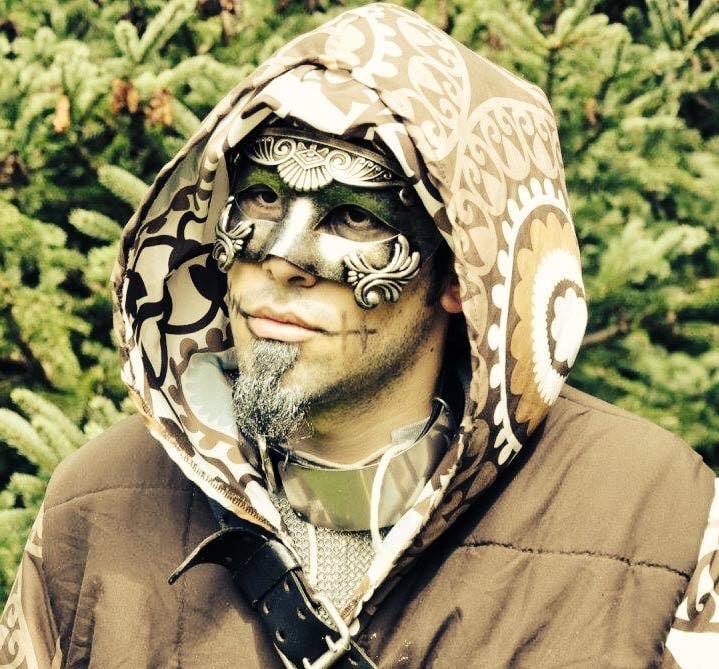
Born of a titanic blow struck upon the Demon Prince Naught centuries ago, this race of mask-clad, human-like Constructs was created when the arcane mask it wore was sundered. The doll-like servants it had created for itself unconsciously drew upon these shards. In doing so, they found themselves awakening all across Arthos as newly independent sentient beings. With little memory of who or what they are, they hungrily seek to understand this world and their place within it.
Language: None (Common)
Life Expectancy: Immortal
Contents
History
 Long ago, when the Firstborn began to wane under the ceaseless assaults of the Celestial Host, the dragon Ixiad launched a desperate gambit. The tutelage and arcane secrets she provided to the Hell King in exchange for his aid against the Gods led to the creation of the demon princes, and more importantly led to the creation of Naught, demon prince of the Void. It could not perceive reality as the others could, nor could it really think or even act on its own. In fact, to call it anything at all would not be accurate. Naught is a paradox, it is the pure essence of nothing, the metaphysical concept of oblivion made manifest. While others became valued lieutenants or fearsome champions, the Hell King could do little but bind his new child with spells and hexes and direct this storm of annihilation at his most terrible foes.
And yet, while it was all but blind to the world due to the nature of its existence, the infinitesimally small piece of the Demon it once was desired to be more than nothing itself. By rites so blasphemous and paradoxical, one would be driven mad by merely attempting to understand them, Naught caged the energies of the Void within its new creation: the First Mask. With this blasphemous artifact, Naught assumed physical shape for the first time and gained the ability to fully observe and understand the physical nature of existence that surrounded itself. Before it had been frighteningly powerful, but effectively blind, deaf, and mute. A force of annihilation to be caged and directed by the Hell King’s will. Now? Now it was its own being, disgusted by all of existence and possessed of the power to unmake all that is, was, and will be.
This mere threat of a possible challenge to his power was not something the Hell King could abide. Whatever the Hell King’s true goals were, they did not include watching his wayward child destroy all of existence and surpass its father. Thus, with a single spell crafted by the remnants of a thousand damned mortals, he shattered the mask and reduced Naught into a fragment of what it once was. And while the mask was certainly broken, such was its power that it was not destroyed, not completely. Instead, the shards were drawn by arcane pathways to the only other beings marked by the demon prince. His doll-like servants, formed from stolen mortal spirits and shaped into unthinking automatons.
The sheer power and trauma of this process severed their link to Naught and forced them from the depths of his hellish domain. Over time they have begun to awaken on Arthos as fully formed sentient beings, free to choose their path and lot in life. And yet, they are still bound by their mask to their former master, and should they meet their final death they will once again join it in the depths of the Hellstack.
Geography
The Faceless are social parasites in the kindest sense, as they have no community or culture of their own to speak of. While many tend to avoid other mortal folk due to the demonic stigma of their origin, those that do live amongst the mortals tend to adopt the beliefs and customs of their chosen people. These tend to be in the smaller and more remote corners of Arthos, as few Faceless do well in large communities. Most mortals look upon the Faceless with superstition and fear, and large groups of ignorant folk motivated by such things often spell doom for the unfortunate Faceless who happens to be nearby. For those that choose to settle alone or in small groups of their kind, places like the desolate tundra of Jormunger or the Dark Fae Isle have proven to be places where they can observe the world relatively undisturbed by it.
Some Faceless are accepted as wards or assistants by powerful magi, who value both their inquisitive nature and unique abilities. It is also believed by these learned folk that should a Faceless meet a final death, their spirit returns to and thus empowers the demon prince of the Void. Libraries tend to be safer than a battlefield, and thus are seen as a way to forestall this grim reunion.
The only group of people that seem to view the Faceless with any sort of positive connotation are the Ajaunti. Some caravans see the Faceless as a poor, wayward spirit to take care of and thus take pity upon them. While some caravans still reject the Faceless as omens of bad luck, on the whole many Faceless come to find travelling homes in the convoys of the nomadic Ajaunti clans.
Rumors carried by these very same convoys speak of a hidden enclave where a settlement of Faceless is said to exist. Some Aja even claim to have delivered supplies or even other Faceless to this hidden refuge, though none have revealed its location even upon pain of death. These whispers speak of a great archmage who rules there; a Faceless simply known as the Second. It is said that she secretly gathers the best and the brightest of her kind to her side, and with their aid has been seeking a way by which they might finally sever the link that binds them to Naught. She has vowed to save her kin from the damnation that awaits them, one way or another.
Culture
All the Faceless have forgotten the names they once held before their spirits were stolen by Naught; any remnants of their previous mortal lives have long since been erased. The same can be said for any designation they might have held while they were little more than demonic servitors. As such, the Faceless alive today tend to choose names based upon the peoples and languages of the surrounding mortal peoples as a feeble way to fit in, while others may instead accept another whom they trust bestowing a name upon them.
Those Faceless that awaken alone instead often tend to choose names referring to negativity or absence. Nothing, Nix, Void, Hollow, and even No are popular titles given to oneself. They see names as a reflection of what they are, and use them proudly despite their usual connotations. To a Faceless there are no emotions tied to names to make them sad, joyous, or strange. A name, in itself, is a gift they are grateful to have.
The venetian mask of a Faceless is akin to its very soul, and each one is said to bear a portion of Naught’s essence and power. While a Faceless wears its mask, no creation in all of creation can feel their presence, not even the Gods themselves. A mask may not be removed by anyone but the Faceless themselves, and they seem to be forcibly bound at the most primal level with the Faceless’ demonic spirit. Even doing so for the Faceless in question requires a great deal of practice and skill, and is an intensely painful process. However, doing so allows the Faceless to transmute the protective aura that hides their nature into an incredibly potent anti-magic shield, shielding them completely from one or more spheres of magic. This lasts for but a few minutes at most, but should the Faceless have reason to, they may choose to remain unmasked for a time even after their protection has faded.
However, doing so causes the Faceless to become a beacon of sorts. Without the aura that disguises their soul, those beings with otherworldly senses find that the Faceless is no longer invisible to their sight. Indeed, whereas before no being could sense their presence, now they appear to sense as anything and everything. Be it elf or orc, blessed paladin or a simple gold coin, they can hide from no one in this state.
While a mask is currently not perched atop the disfigured and scarred face of a Faceless, it still may not leave their presence. Any attempt to do so will simply see the mask dissolve into black mist, before appearing again in the presence of the Faceless. Still, all Faceless will guard their mask with their life, and any attempt to take it from them will inevitably cause the Faceless to feel extreme pain and fill them with rage. It is as much a part of them as their very spirit is, and in a very real sense it is them. Some Faceless think that all they are is the mask, and their body is merely an empty vessel upon which they ride.
The exact composition of each mask varies, with a wide variety of materials and flourishes recorded by those who study their kind. All are indestructible, and the Conclave’s magi have concluded through rigorous testing that they are completely immune to all forms of magic they can muster. At best, they can determine some amount of demonic magic is latent within the mask, but its nature or purpose beyond its link to Naught remains unclear.
Their unfortunately-tainted spirits lend the Faceless a certain weakness common to all of demonkind: a vulnerability to psionic magic. Mind Magic is universally feared by all Faceless as their mask cannot protect them from it, with many seeking other occult ways to avoid it. Some carve tiny wards, burn incense, or even hang bells in the doorways of their homes to warn them of the coming of psionicists. Others tend to threaten swift and vengeful action should anyone dare cast it upon them. A Faceless will generally only trust a psionic caster under the circumstances of them being a Demon Hunter, and even then only if they were already comfortable in their presence. Many are thus paranoid around magi whose capabilities they are uncertain of.
Marriage and Mating
Children do not exist amongst the Faceless, nor are they capable of creating more of their kind through the reproductive act. Like mules, they are entirely sterile, despite having otherwise functional humanoid bodies. While their exact numbers are unknown, scholars of the demonic are reasonably confident that said numbers are finite.
However, that does not mean that all Faceless are celibate or abstain from romantic entanglement. Romance amongst each other is rare, as the Faceless are so uncommon they rarely meet more than a handful of their kind even over the course of centuries. While a bit less rare, Faceless still have trouble with forming deep romantic attachments to the other mortal races. The stigma surrounding their demonic origin and strange appearances means that the opportunities to form such connections are often rare, but that in turn tends to make them all the more meaningful when they do occur. A Faceless that finds someone who accepts them, someone who sees into their spirit and loves what they see, will be treasured by that Faceless until the end of their days.
The nature of agelessness means that those who fall in love with the mortal races often find themselves heartbroken, as time takes its toll upon their beloved while they themselves remain unchanging. Some Faceless instead pursue romance with other ageless beings, or seek to preserve their partner’s lifespan through alternative means. This has the potential to lead to tragic results, with some resorting to vile and despicable acts of villainy in the name of preserving or restoring an aging or dead partner. The wisest amongst the Faceless often attempt to teach the rest of their kind about the necessity of learning how to let go, and not letting attachment be twisted into a dangerous obsession.
Religion and Superstition
Lacking any sort of homeland or unifying culture, the Faceless tend to be very individualistic with regards to how they approach matters of faith. Whatever culture they happen to settle in amongst will likely have more bearing upon such things than their nature in and of itself. That being said, most Faceless tend to utterly reject the demonic. They will fight to the last breath to avoid demonic subjugation, and similarly few would ever even consider giving away their true name to a wytch or accepting anything from a demon.
The worship of Gods tends to be slightly more common, as the Celestials are often seen as direct adversaries to their demonic masters. Haldora has been known to shelter this race of outcasts, and Dietremen’s faith suits their often inquisitive and distant personalities. Some believe that their demonic origins are a form of corruption, and seek redemption within the church of Cassandra.
Those who follow the Firstborn are rarer still, and tend to number amongst those peoples that live closer to the natural world. Through the cycle of rebirth that the dragons promise, they hope to regain what they lost when Naught claimed their spirits and turned them into its slaves. Those who follow Illyxtirak seek a pure, primal connection with the world untainted by all the superstition and bias that civilization offers, while those who follow Tezoth seek to prove that their origins do not define them, and that anyone has the potential to be a force for good in this world.
The reverence of Ixiad is one of the few cultural taboos the Faceless have. The Spider Dragon is hated by nearly all for her part in creating their former demonic master, and most would never willingly associate with her or her servants. Each rule has its exceptions, however, and it is said that one of her oldest Knights is a renegade Faceless who has chosen the name Advocate. Most believe that he gave up and decided servitude to Ixiad was the only real method that might save him from Naught’s jaws should he die a final death, but whatever the case may be, it is certain that he is a creature of frightening power and stature in her service.
Common Personalities and Views
Faceless are usually very inquisitive, as all awake as fully formed adults with no memories to call their own. Many learn to read as fast as possible to begin researching and cataloging the world around them. Others tend to analyze as they go, choosing to keep all data attained locked in their minds. Their time spent under the tyrannical control of Naught is completely lost to the sands of time. This memory hole does not seem to bother the Faceless, in fact most take comfort in the fact that they cannot remember those horrors. However, most still feel a strong aversion to anything that hints at that time in their existence, with many living in fear of their old master.
While many do walk the scholar’s path, not all Faceless seek to understand their world through analytic study. Some instead turn to more artistic modes of expression as a way to touch the more ephemeral aspects of existence. Through art they seek to understand emotion, beauty, and truth while touching the very spirit of Arthos itself. Painting in particular seems to be a favoured trade, with some Faceless even winning a measure of respect from the mortal races for their sublime works.
Faceless sometimes move with a strange gait, as if their limbs were being yanked or pulled around by hidden strings. Clicking, whirring, or creaking sounds can sometimes be heard from them, as well as twitching movements. While medically a healthy Faceless has no abnormal joints nor strained musculature, these sounds and movements often persist despite medical attention. Many doctors who have worked on Faceless patients have thus concluded that this is purely psychosomatic behavior.
Due to their awkward mannerisms and frightening visage, most mortal folk call the Faceless by the moniker of Puppet People or Dolls. As such, the race is widely distrusted by the other folk of Arthos. Many people see them as freaks of nature akin to the Undead. Even those ignorant of their nature tend to be suspicious of folk who go around wearing a mask everywhere.
While the Faceless do not possess a racial language, they tend to learn the common tongue extremely quickly. Mirroring the language they hear akin to an infant, they have a remarkable talent for the swift acquisition of foreign tongues. Many Faceless tend to speak in a quiet whisper, but speech patterns do vary from Faceless to Faceless.
The Faceless also do not seem to sleep as most mortals do, instead seeming to simply turn off like an animated toy. They naturally go limp, and slip into a trance-like state when they feel the need to rest. They do dream, but their dreams seem to cross realities and often conjure frightening imagery or even fragments of their past lives. The concept of sleep as mortals understand it is foreign to the Faceless, with many not fully understanding it even after having it explained to them by a patient mortal.
Roleplaying Tips
The Faceless are very strange creatures, with a zest for information gathering and many other odd hobbies. They can take on many roles and fit many classes well. When playing a Faceless, remember the following:
- Move in weird ways like a marionette. Be spooky sometimes!
- Always try to attain more information. Ask weird questions like, “what colour is the sky? What are Kobolds? What shade is moonlight?”
- Find a weird quirk and incorporate it!
- Customize your Venetian mask in accordance with your character’s personality.
- You are strange, embrace that!
View on Other Races
Faceless treat other races with childlike wonder, yet a wizened curiosity. Races are new and complex things to observe and learn from; even the “scary” ones.
Humans: “Where is your mask? Do you want one?”
Ajaunti: “Subtype. Wondrous. Do not offend.”
Einher: “Subtype. Lots of yelling.”
Hobling: “Very small. Very jovial.”
Orcs: “Goblinoid. We understand hate of charms. Fighters.”
Mountain Dwarves: “Beard… itchy. Strong and talented.”
High Elves: “Pointed ears. Pointed comments. Resist the mind.”
Dark Elves: “Subtype. Subterranean. Alchemical geniuses. Do you want a mask?”
Wild Elves: “Subtype. Natural. You attune to existence.”
Gargylen: “Empathy. We are sorry.”
Wood Fae: “Happiest reproduction of original. You break ensorcellment.”
Avians: “Call us… Shadows? We are… sorry?”
Draconians: “Children of scales. Share your knowledge of the forever.”