

Suvant
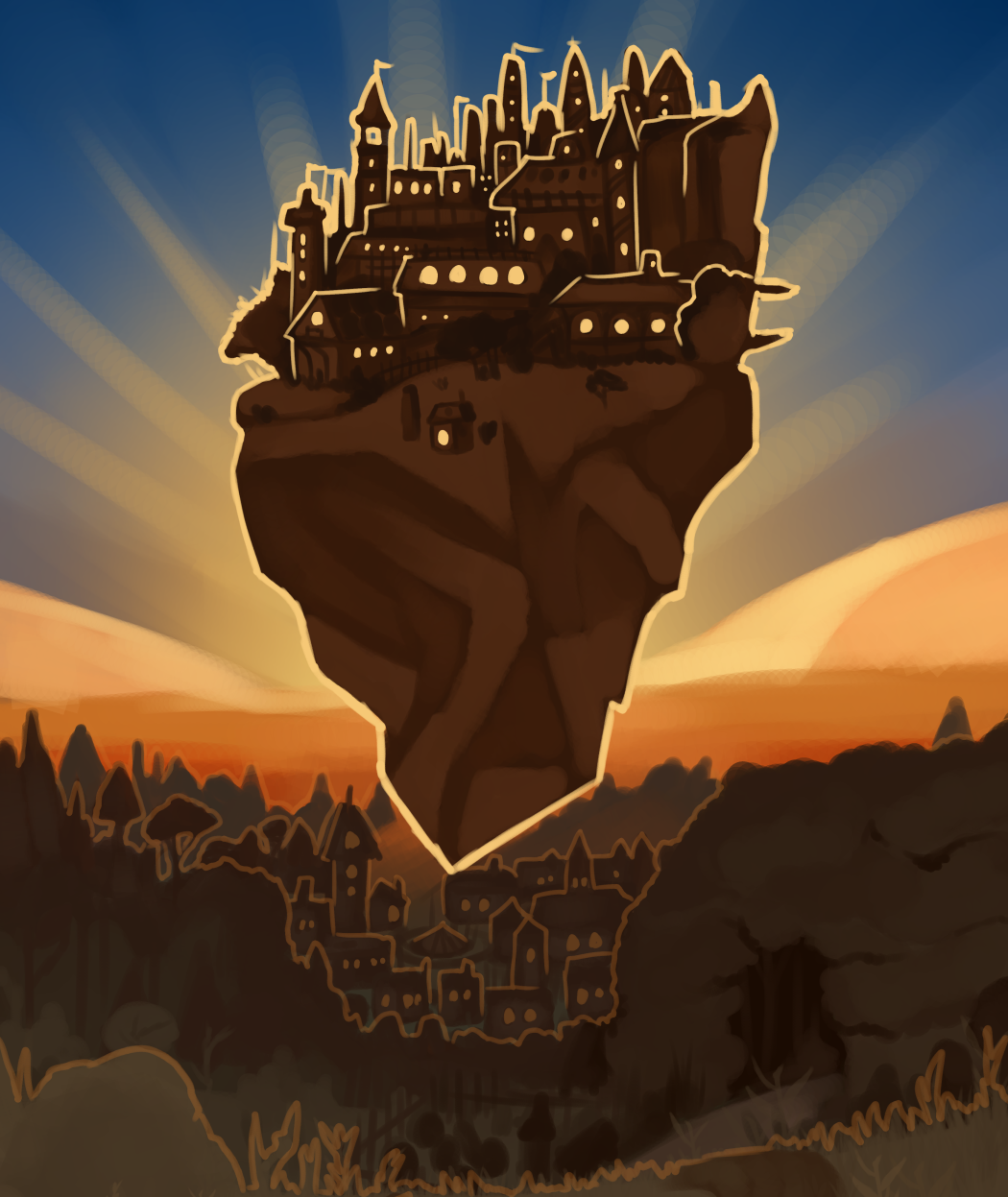
Suvant was the capital city and kingdom of the High Elves (Deminis’Thalan), serving as their political and cultural center on the continent of Arthos. Originally established as a small terrestrial nation southeast of the Kingdom of Tiefanue, Suvant mysteriously vanished along with the Grey Elves of Maud’madir, only to return later as a magnificent floating city held aloft by powerful magic, eventually relocating above the island of Day’ten. The kingdom met its catastrophic end in 2261 during the War of Amaranthia, when the floating city crashed to earth in one of the most devastating events in recorded history.
Despite its relatively small size, Suvant wielded influence far beyond what its borders might suggest. Known as “The Homeland” to High Elves across the continent, it housed the most advanced Guilds of Magic in the known world, rivaling even Berphaunt’s prestigious Conclave. The kingdom’s pursuit of magical knowledge was held in almost religious reverence, with most citizens, even peasants on Day’ten, receiving formal instruction in the magical arts. This universal magical education made Suvant unique among the nations of Arthos and cemented its reputation as the pinnacle of High Elven civilization.
The kingdom maintained strong cultural and political ties to the Grey Elves, with High King Baraquiel Hopebringer of House Tse Tannonoth serving as both a link to their shared heritage and a ceremonial leader of the Council of Twelve. This system of noble governance balanced the interests of the nine major houses while preserving the ancient connections between the High Elves and their Grey Elven ancestors. The interplay between these noble houses, particularly the ideological rivalry between House Shalonost and House Sumendar, would ultimately contribute to the kingdom’s dramatic rise and catastrophic fall.
Contents
History
Origins and the Grey Elven Connection
According to elven historical records, Suvant was founded by one of the five factions that emerged after the catastrophic human rebellion against the Grey Elves. When humans violently overthrew their Grey Elven mentors, murdering the High Council of Light and burning the Grey Elven capital of Tse Maigrindof, the surviving Grey Elven parliament fled to the deep woods and divided into five distinct groups. The faction that would become the High Elves “desired to understand the actions of the humans, and even went so far as to sympathize with them.” They wanted to grant humans their freedom and establish strong foundations with this vibrant race, believing humans possessed “a lust for existence that was at times difficult to invoke in a people that possessed a lifespan of almost a thousand years.” This faction followed the humans as they migrated west and eventually founded the Kingdom of Suvant. This philosophical foundation would shape how the High Elves approached their new kingdom.
Foundation and Early Period
Suvant was established as a small nation southeast of the Kingdom of Tiefanue, becoming the political center for the High Elven population on the continent. The kingdom distinguished itself through peaceful foreign policy, maintaining an alliance with Felnir while avoiding expansionist ambitions.
During the Eastern War between Berphaunt and Clan Sprawn, Suvant maintained its characteristic diplomatic stance. Historical records note that “Suvant had written so many formal letters of shock and repulsion at the ‘barbaric, unannounced attacks’ to Berphaunt it was wondered if there was any paper left on Suvant shelves.” Following the war, Suvant joined the “Triple Alliance” with the Republic of Duvain and the Kingdom of Tiefanue, which was officially “an alliance of economic support” but functioned as “a three-pronged guard against a routed but still dangerous Berphaunt military.” During the subsequent period of continental conflicts (2220-2229), Suvant remained notably neutral, with historical records stating: “Little has changed within the Kingdom of the High Elves, and they remain as neutral in world affairs as always.”
The Mysterious Disappearance
The Grey Elves disappeared in 2234 when the ruins of Tse Maigrindof vanished, speculatively to avoid the torrent of necromantic splinters known as “Boneshards” raining down from the explosion of the Ridge of Sindar in late 2233. Shortly after in 2236, Suvant itself vanished completely in similar fashion. In both cases, no structures remained, and the lands became overgrown as nature reclaimed them. The Kingdom of Tiefanue quickly expanded to fill the gap to the sea before another nation could claim it. The disappearance of Suvant had profound effects on High Elves across the continent.
While Suvant was absent from the world, several significant events occurred that would later affect the returned kingdom. The Savar’Aving plague of 2235 may have been connected to the same forces that caused the Grey Elven disappearance, but such has never been proven. The establishment of various magical barriers and conflicts with undead forces created the conditions that would later require the Curtain’s construction; a powerful arcane bulwark to hedge out the advance of the Cursed Forest near the Town of Jericho.
During this period of absence, High Elven refugees established the island settlement of Day’ten near where Suvant had once stood, creating a community of 3,000 High Elves with fishing and various crafting industries. The reason for Suvant’s disappearance remains one of the greatest mysteries in continental history but it is assumed to be somehow related to the Grey Elves. In 2238, the remaining High Elves attempted to rebuild in the recently claimed Western Kingdom lands but were persuaded by Tiefanue military forces to move off the continent to an isle south of the old Sindar. The following year, the High Elven refugee city of Day’ten was officially established and began reestablishing political ties with other nations.
Return as a Floating City
In late 2250, Suvant dramatically reappeared as a floating city suspended several hundred feet above Day’ten island. The city was held aloft by four massive crystalline mana sources, representing the pinnacle of High Elven magical engineering. Massive pulley systems were constructed to transport people and goods between the floating city and Tourquet port below.
The return began in November 2250 when the once vanished ruins of the Grey Elven capital Tse Maigrindof appeared in the Cursed Forest near Jericho, with Suvant hovering in the air above it. Later in December, Suvant moved to appear in the skies over Day’ten, where it remained. Baraquiel Hopebringer of the Grey Elves was crowned as the new High King of Suvant, restoring the ancient connection between the two elven peoples.
In January 2251, Berphaunt and Suvant formed an alliance against Inviticus, and the alliance invited Jericho to join them in creating a magical Curtain to stop undead from passing from the south, which Jericho accepted. By March 2251, Suvant made the strategic decision to retain the military forces of Day’ten as a defensive force, which had originally been planned for disbandment upon Suvant’s return but proved more competent than a simple peasant army.
In July 2251, Suvant expanded its territory by annexing the independent town of Jericho after the successful construction of the Curtain. The kingdom declared Jericho as part of their realm and sent Lord Councilor Jatar Sumendar to rule for the rest of the year, with the outpost town accepting the new arrangement. The small Army of Day’ten was incorporated into Suvant’s military forces rather than disbanded, significantly expanding the kingdom’s defensive capabilities on land.
Political Crisis and Civil War
The kingdom became increasingly divided between two major factions during the War against Ga’more (2257-2261). House Shalonost, controlling the official government, aligned Suvant with the Empire of Berphaunt. However, House Sumendar was ousted from power and formed a “government in exile” that joined the Whiteraven Alliance, creating two competing Suvantian governments.
In July 2252, Reann Tanna of House Tanna arrived to succeed Jatar Sumendar as Jericho’s ruler, implementing significant religious restrictions by disestablishing the Church of Light and forbidding public worship of the Gods. The following September, forces sent by House Shalonost destroyed the last remnants of Clan Grosh near Jericho, demonstrating Suvant’s military reach. However, in April 2253, Reann Tanna was exiled from Jericho through the intervention of an Angel of Light.
This schism deepened when Jatar Sumendar, representing the Suvantian Resistance, was killed in combat against the Brood. His sister Ulya Sumendar replaced him as the exiled government’s representative, setting the stage for the final confrontation that would destroy the kingdom.
Geography
The Floating City
Suvant’s most remarkable feature was its transformation into a floating metropolis suspended hundreds of feet above Day’ten island. The city was kept aloft by four crystalline mana sources that channeled magical energy to maintain its aerial position. These power sources were considered marvels of magical technology and were both studied and envied by mage’s guilds throughout the known world.
The floating city featured great gardens to maintain a spiritual connection to nature while providing security from ground-based threats. The elevated position offered both practical defense and comfort to its residents, many of whom rarely ventured to the ground after years of aerial living.
Day’ten Island
Day’ten served as Suvant’s terrestrial territory and primary access point. The island had a semi-tropical climate and supported a population of 3,000 High Elves across several settlements:
- Tourquet: The major port town serving as gateway to Suvant, featuring the massive pulley systems connecting to the floating city above
- Bein Gaer: A fishing village of twenty families across the river from Tourquet
- Oberne: A farming town in the northeastern hills
- Lond: A fishing village on the north coast
- Duron: A west coast fishing village known for pearl diving
- Laval: A shrimp fishing village near mangrove swamps
The island’s economy centered on fishing (taking advantage of nutrient-rich river mouth waters) and agriculture including coffee, with Day’ten coffee beans prized throughout the continent.
Infrastructure
All trade to Suvant flowed through Tourquet, where specialized engineering transported goods and people to the floating city. The pulley systems spanned the great distance between the port and city above, requiring constant maintenance and representing a possible vulnerability in the kingdom’s logistics. These massive mechanical lifts were marvels of High Elven engineering, combining traditional craftsmanship with magical enhancement. The pulleys were crafted from enchanted metals that could bear enormous weights, while the cables were woven from crystalline fibers infused with protective magic to prevent wear and sabotage.
The transportation schedule operated like clockwork, with designated times for different cargo types and passengers, creating a constant mechanical hum that became Tourquet’s signature sound. Emergency protocols allowed the entire floating city population to descend to Day’ten within hours if necessary. While the floating city could relocate if threatened, the complex pulley infrastructure represented a significant investment that tied Suvant’s prosperity to Day’ten’s stability and made relocation a costly last resort.
Government and Politics
The Council System
Suvant was governed by the Suvantian High Council, also known as the Council of Twelve. The council included representatives from major noble houses, though not every house held seats and some houses held multiple seats based on their political influence.
The system included a unique 13th member: High King Baraquiel Hopebringer of House Tse Tannonoth (Grey Elves), who only voted in cases of council ties. After Baraquiel was deposed, Jjik’da Shalonost of House Shalonost assumed the role of Arbiter, though this transition became a source of significant political tension.
Council Composition
The council’s final composition before the kingdom’s destruction included:
- House Shalonost (3 seats): Jjik’da Shalonost (Elder Bladesinger), Victor Shalonost (Ranger), Kelestria Shalonost (Druid Novitiate)
- House Sumendar (2 seats): Ulya Sumendar (Elder Bladesinger), Jatar Sumendar (Druid)
- House Tar-Esiir (1 seat): Kydak Tar-Esiir (Elder Mage)
- House Valisilwen (3 seats): Malim Valisilwen (Cleric), Randae Valisilwen (Mage), Kirin Valisilwen (Ranger Novitiate)
- House Tanna (3 seats): Cypharia Tanna (Elder Mage), Reann Tanna (Warrior), Mikelia Tanna (Warrior Novitiate)
Council Aides represented houses without full seats: Elrohir Míriel (House Eledhwen), Eleyond Nibenon (House Sidhion), and Vendethiel Kan (serving the High King).
How council members were chosen remained secret, known only within Suvant high nobility itself. The selection process was never made public knowledge, adding an element of mystery to the kingdom’s governance.
Social Hierarchy
Suvant maintained a merit-based social structure with the following hierarchy:
- The Council of Twelve House Elders
- The Noble Families/Commanders of the Military
- Master Artisans or Master Merchant Artisans
- Lesser Noble Families/Officers of the Military
- Merchants/Soldiers of the Military
- Free Citizens
- Peasants
Special titles included Lore Keepers (House Sha’relas members), Bladesingers (elite warriors), Priests of Ll’yandra (religious officials), and Elders (advisors to nobles and councils).
Noble Houses
House Shalonost
House Shalonost was one of the eldest and most powerful houses, led by Jjik’da Shalonost. Considered the “richest” house in more than just monetary terms, they accumulated wealth and influence through rumored involvement in “the tasteless duties needed to keep Suvant safe,” suggesting espionage or other covert operations. The house consistently worked against the High Grey Elven King, viewing him as merely symbolic, and positioned themselves as the true power in Suvant. Mystery and unconfirmed rumors surrounded their activities, which they neither confirmed nor denied. Their house symbol was a horse.
Key Members:
- Jjik’da Shalonost: Elder Bladesinger, former ambassador to Sindar
- Victor Shalonost: Jjik’da’s right-hand for nearly a century, accomplished ranger and military leader
- Kelestria Shalonost: Adopted orphan, “dark druid”, sent to rule Jericho as Lady Councilor in 2254
House Sumendar
House Sumendar served as House Shalonost’s ideological opposite, strongly supporting the High Grey Elven King and royal authority. Led by Elder Bladesinger Lady Ulya Sumendar, they embodied heroic High Elven ideals and were beloved by the populace. Ulya was so popular that children received “Ulya dolls” as Yule gifts. Their house symbol was a hawk, representing keen sight and noble character.
Key Members:
- Ulya Sumendar: Living hero, Elder Bladesinger, head of house after brother’s death, eventually led government in exile
- Jatar Sumendar: Younger council member, druid with adventurous spirit, served as Jericho’s Lord Councilor before dying in combat against the Brood
House Tar-Esiir
House Tar-Esiir was the eldest of all council houses but was in decline. Once the dominant power and “Suvant’s version of the Conclave,” they were viewed by younger generations as painfully old-fashioned in magical studies. Led by Kydak Tar-Esiir, a master mage seen as a “crotchety and doddering crazy old mage,” though he remained an expert in Suvant history and lore. Their house symbol was a candle and book together, representing learning and illumination.
Key Member:
- Kydak Tar-Esiir: Oldest council member, master magi who resisted Conclave influence, advisor to the Grey Elven King, died in 2254 after being turned into a Lich
House Valisilwen
House Valisilwen served as mediators during council meetings, led by Malim Valisilwen, a well-known cleric of Ll’yandra. They remained neutral in political conflicts, making decisions based on logic rather than emotion, always with Suvant’s best interests in mind. The house had strong ties to the Church of Ll’yandra and used the Goddess’ holy symbol as their house symbol.
House Tanna
House Tanna was the youngest council house, founded by sailor Meltheldonon Dathen and the mysterious Cypharia Tanna. After Meltheldonon’s death, Cypharia took control and built the house into a power-hungry faction that aligned with House Shalonost. Led by the cunning Lady Cypharia Tanna and her cruel son Reann, they made no attempt to hide their political ambitions and usually voted against the High King. Their house symbol was a mermaid.
Key Members:
- Cypharia Tanna: Passionate and driven leader, ritual casting mage, known for political battles with Kydak Tar-Esiir
- Mikelia Tanna: New to the council with little public information available
House Tel’Montain
House Tel’Montain was primarily a military house that never sat on the Council due to their large standing forces. Founded in 517 by Genevieve Shalonost and evolved from a steel monopoly into a martial organization, they maintained exactly 527 elite knights trained in multi-racial combat traditions. Led by Patriarch Adrien Tel’Montain, they shared diplomatic ties with both House Shalonost and House Sha’relas. Their house symbol was a sabre of High Elven design.
House Sha’relas
House Sha’relas held the unique position of neutral chroniclers and historians, led by Erebron Sha’relas. Members held the prestigious title of “Lore Keeper” and maintained strict neutrality in all Suvantian conflicts. They never sat on the Council to avoid compromising their role as impartial historians, and it was considered a high crime to interfere with a Lore Keeper. Their house symbol was a long, feathered quill.
House Fleau
House Fleau was a minor Suvantian noble house known for their military service to the kingdom. While not major political players, they earned respect through loyal service, with their most prominent member being their House Lord Sieur Abatt’age Fleau, Poing Fortifié du Suvant, or “The Fortified Fist of Suvant” in the Common tongue. Sieur Fleau played a crucial role in the final battle against the Brood during the War of Amaranthia. Their symbol is a black gauntleted fist over a royal blue background.
Military
Organization and Forces
Suvant’s military was much smaller than most major kingdoms but highly specialized, emphasizing magical integration and elite training. Unlike the massive conscript armies of neighboring powers, Suvant focused on quality over quantity, with every soldier receiving magical instruction to complement their martial skills. This approach reflected the kingdom’s cultural values, where even common soldiers were expected to demonstrate proficiency in both blade and spell. The military grew significantly when Day’ten’s forces were incorporated, adding substantial numbers while maintaining the kingdom’s standards of magical competency.
The Day’ten incorporation brought a substantial land force under Captain Joest, including elite High Elf soldiers, numerous peasant archers and swordsmen, dedicated High Elf mages, and siege equipment. The naval forces included both High Elf warships with full crews and smaller peasant vessels for coastal operations. While these Day’ten forces were originally considered “peasant armies,” they proved more competent than expected and were retained rather than disbanded, significantly expanding Suvant’s defensive capabilities both on land and at sea.
Elite Units
Suvant was renowned for its bladesingers, elite warriors who wove magic and swordplay into a deadly art form that resembled an elaborate dance. These master combatants used spellwork to enhance their blade techniques, with enchanted weapons becoming extensions of their magical will. The title of Bladesinger was earned only through exceptional service and skill, marking those who had achieved legendary status as protectors of the realm.
Military leadership generally came from lesser noble houses, though these were less respected than houses focusing on magic or artistry. House Tel’Montain represented the pinnacle of Suvantian military excellence with their elite knights.
Economy
Trade and Industry
Suvant’s economy was mostly built around magical services, artisanal goods, and Day’ten’s natural resources. All major trade flowed through Tourquet port, creating a natural economic chokepoint that benefited both security and revenue collection.
Primary Industries:
- Magical services: Advanced magical research, enchanted items, and educational services
- Artisanal goods: High-quality craftsmanship blending magical enhancement with aesthetic beauty
- Coffee production: Day’ten coffee beans were prized throughout the continent
- Fishing industry: Multiple specialized operations including pearl diving and shrimp fishing
The kingdom maintained a sustainable economic model that focused on steady growth rather than rapid expansion, funding their renowned magical schools and ensuring that even Day’ten’s fishing villages had access to basic magical instruction.
The Destruction of Suvant
Political Crisis (August 1st, 2261)
The final crisis began during the War against Ga’more when political tensions between House Shalonost and the exiled House Sumendar erupted into open confrontation. On the island of Melinda, with Suvant floating above, Lord Jjik’da Shalonost and Lady Ulya Sumendar argued over military leadership for the final assault on Amaranthia.
When Jjik’da declared “We ARE the Empire here!” in defiance of Emperor Louis Berphaunt, the Emperor arrived with Archbishop Roderick Hale and used holy relics to bind Jjik’da in divine chains. The Emperor then forcibly transferred control of Suvant to Ulya Sumendar, completing a political revolution that saw House Sumendar regain power while House Shalonost was arrested.
The Final Battle (August 2nd, 2261)
Following the political upheaval, the purple dragon Essyllt transported Suvant through the Far Realm to Amaranthia for the final assault against Ga’more. The floating city served as a mobile fortress, deploying coalition forces while participating in the attack on the Prism Discordia. All citizens had been evacuated prior, with most temporarily waiting in Melinda or Day’ten.
During the battle, Sieur Abatt’age Fleau, Lord of House Fleau, lit the signal for Suvant to join the attack and batter down a tsunami-sized wave of black brood that stood in the way of the ground forces. High Elven and Conclave mages channeled spells into the ancient crystals at the center of Suvant’s towers, preparing for a magical bombardment against Ta-Ba-Ret wearing the skin of the dead God of Domination, Ga’more.
The Catastrophic Fall
Ta-Ba-Ret’s black Mirrorshell Brood countered the bombardments and ricocheted them back at Suvant with multiplied force. The attack overwhelmed the city’s magical defenses, causing three of the four crystalline mana sources to crack and break apart. Eldritch blue flames leaked across the city’s underbelly, creating magical explosions and shattering stone and crystal throughout the floating city.
With only one power source remaining, Suvant began an uncontrolled spiral downward. The floating city crashed to earth like a meteor, creating an earth-shaking impact that could be felt across the landscape. The once magnificent capital partially exploded and burned upon impact, destroying centuries of accumulated knowledge, art, and magical research. However, the fallen city did not vanish entirely. Suvant’s ruins remain on Amaranthia, likely standing at an angle in a massive crater, with towers partially collapsed and streets buckled by the impact. The floating city’s magical infrastructure was shattered, its libraries burned, and its military forces devastated, but the ruins of the once-great city endure.
Supernatural Consequences
The mass elven casualties from Suvant’s destruction had an unexpected supernatural effect: the deaths accelerated the Mortigeist’s power enough to break free from his Mizzer’baugh prison immediately. The legendary terror of elves was released onto the battlefield alongside hordes of Shattered Elves, creating a secondary catastrophe.
In the chaos that followed, Enna Summerlark, Paladin of Ll’yandra, stood fast against the incoming tide of Shattered Elves, cutting through swathes of them to give her elven brethren a chance to flee. Her sacrifice allowed countless elves to escape the unleashed threat.
Legacy and Aftermath
Immediate Impact
The destruction of Suvant created a massive refugee crisis, with surviving citizens housed in temporary camps on Melinda. Day’ten island, having survived the floating city’s destruction, became the primary refuge for Suvantian survivors and the de facto continuation of High Elven political organization.
Jjik’da Shalonost was rumored to have been released during the chaos, with surviving Shalonost forces later attacking Emperor Berphaunt’s camps, adding civil conflict to the already devastating situation.
Political Reorganization
The elaborate Council of Twelve system ended with Suvant’s destruction. Surviving High Elven political structures reorganized around Day’ten’s more practical governance systems, with Captain Joest’s military administration providing stability during the rebuilding period.
The old noble house rivalries ended abruptly. Centuries of political tradition vanished along with the city, replaced by the urgent demands of rebuilding.
Historical Significance
Suvant’s destruction shocked the continent and marked the final end of the great High Elven kingdom. The loss of the floating city, with its advanced magical knowledge and legendary Bladesingers, left a void in continental politics that would never be filled. Day’ten’s survival meant that High Elven culture and traditions continued, but the grand ambitions and magical supremacy that Suvant represented died with the city’s fall.